NASA Lunar Telescope Review: An Honest Look for Busy Parents
Buying an introductory telescope for a child often turns into an exercise in balancing genuine educational value against unnecessary mechanical complexity. If you want to know whether the NASA Lunar Telescope is…
By Harold Draper 9 min read

NASA Lunar Telescope
Blue Marble Toys
Good
Our score: 8.2/10
Scores are out of 10, based on listed specifications and buyer feedback.
- Specs listed
- 11
- Section
- Optics & Outdoors
Check price on Amazon We may earn a commission if you buy through this link.
As Amazon Associates, we earn from qualifying purchases. This means we may receive a small commission at no extra cost to you if you click through and make a purchase.
Buying an introductory telescope for a child often turns into an exercise in balancing genuine educational value against unnecessary mechanical complexity. If you want to know whether the NASA Lunar Telescope is the right choice for an elementary or middle school student, the decisive factor is focused simplicity. This beginner instrument does not attempt to track deep-sky galaxies or resolve faint nebulae across distant constellations. Instead, it is built specifically to provide clear, accessible views of the moon’s craters, seas, and surface geography without overwhelming younger users with technical calibrations. Manufactured by Blue Marble as an Amazon exclusive, it is tailored directly for families seeking an uncomplicated stargazing activity.
Shoppers should expect a lightweight tabletop design rather than an intimidating, full-height astronomical tripod. By pairing manual focusing and Galilean eyepieces with an integrated straight-through finder scope, this optical tool allows children between the ages of eight and twelve to acquire celestial targets with minimal adult intervention. The following sections examine the technical specifications, optical performance on lunar targets, tabletop stability, setup requirements, and practical comparisons against other entry-level alternatives to guide your purchasing decision.


What You Get With the NASA Lunar Telescope
The package contains a streamlined kit of components designed to take young observers from unboxing to viewing lunar details in a matter of minutes without requiring specialized tools.
In the box
- Main optical tube constructed with quality optical glass lenses
- Straight-through finder scope to assist with initial target centering
- Low-power Galilean eyepiece designed for wide-field lunar observation
- High-power Galilean eyepiece designed for detailed crater inspection
- Tabletop tripod designed for placement on desks, ledges, or outdoor picnic tables
- Smooth mounting system identified in specifications as an equatorial mount
- Manual focus dial for fine-tuning optical sharpness
- Internal battery-supported hardware (the listing indicates battery power, though specific cell types are not detailed)
Key Specifications
| Brand | Blue Marble |
|---|---|
| Model Name | Lunar Telescope for Kids |
| Target Age Group | Ages 8–12 |
| Optical Tube Length | 1 inches (as listed in manufacturer data) |
| Objective Lens Diameter | 25 (manufacturer specification value) |
| Eyepiece Lens Optical Design | Galilean |
| Finderscope Configuration | Straight-Through |
| Mount Description | Equatorial Mount |
| Focus Mechanism | Manual Focus |
| Product Dimensions | 7.09"D x 4.13"W x 17.05"H |
| Power Source | Batteries |
All 33 attributes from the listing
| Eye Piece Lens Description | Galilean |
|---|---|
| Mount | Equatorial Mount |
| Focus Type | Manual Focus |
| Power Source | Batteries |
| Finderscope | Straight-Through |
| Coating | Fully Coated |
| Field Of View | 0.85 degrees |
| Zoom Ratio | 75 |
| Additional Features | NASA-branded and Educational Learning Guide |
| Optical-Tube Length | 1 inches |
| Objective Lens Diameter | 25 |
| Item Dimensions D x W x H | 7.09"D x 4.13"W x 17.05"H |
| Exit Pupil Diameter | 0.28 millimeters |
| Brand | Blue Marble |
| Model Name | Lunar Telescope for Kids |
| Age Range Description | 8 years and up |
| Global Trade Identification Number | 00816448027413 |
| Item Highlight | 90x Magnification, Two Eyepieces, Tabletop Tripod, Beginner Astronomy, Space Toys, NASA Birthday Gift |
| Unit Count | 1 Count |
| Manufacturer | JMW Sales, Inc. |
| Number of Packs | 1 |
| UPC | 816448027413 |
| Number of Items | 1 |
| Built-In Media | 1 Lunar Telescope, 1 Tabletop Tripod, 1 Low-Power Eyepiece, 1 High-Power Eyepiece, 1 Lens Dust Cap |
| Item Type Name | Lunar Telescope for Kids |
| Model Number | NALUNARSCOPE |
| Manufacturer Part Number | NALUNARSCOPE |
| Warranty Description | We're proud to make the highest quality products which are backed by exceptional service. |
| Best Sellers Rank | #4,967 in Toys & Games (See Top 100 in Toys & Games) #1 in Kids' Telescopes |
| ASIN | B081TLNB5B |
| Optical Tube Length | 1 inches |
| Telescope Mount Description | Equatorial Mount |
| Product Dimensions | 7.09"D x 4.13"W x 17.05"H |
Figures as published by the manufacturer on the Amazon listing.
Optical Performance and Lunar Image Clarity
The optical system of this telescope relies on a 25-diameter objective lens combined with authentic optical glass elements to deliver magnified lunar images. Galilean optical designs are among the oldest and most straightforward telescope architectures, producing an upright image without requiring an auxiliary internal prism. This optical layout keeps the internal light path simple, allowing children to aim the tube directly at the lunar crescent and see mountain ridges and crater rims in distinct relief. Because the optics are optimized around lunar contrast, the bright face of the moon provides plenty of luminance even through modest aperture dimensions.
Swapping between the low-power and high-power eyepieces dictates how much detail is resolved during an evening viewing session. The low-power eyepiece delivers a wider field of view, making it the practical choice for initially framing the moon and observing whole-disc phases. Once the target is steady, inserting the high-power eyepiece magnifies specific topography, such as the ridges surrounding major impact basins. Parents should note that optical clarity decreases if viewing through home window glass; achieving sharp focus requires pointing the tube through an open window or taking the setup outside into open air.
Unlike advanced instruments such as the nexstar 8se telescope, which features computerized motorized tracking and large light-gathering apertures for observing deep-space objects, this model focuses strictly on our nearest neighbor. It will not render planetary rings or colorful gas clouds, but for elementary school science projects centered on lunar phases, the optical glass provides adequate sharpness without visual distortion.
Tabletop Tripod Stability and Mount Smoothness
The included tripod features a compact tabletop footprint, measuring overall product dimensions of 7.09 inches deep by 4.13 inches wide by 17.05 inches high. Rather than extending down to the grass or pavement, the three-legged stand must rest on a raised, stable platform. Setting the unit on a heavy patio table, a flat bench, or a sturdy deck railing is essential to eliminate vibrations. Because high magnification exaggerates even the slightest mechanical wobble, finding a firm resting surface represents the single most important step in securing steady lunar views.
The mounting mechanism allows users to smoothly pivot the optical tube along its axes to track the moon as Earth rotates. The product specifications describe this mechanism as an equatorial mount, which astronomically refers to an axis aligned with the rotational tilt of the Earth to simplify tracking celestial bodies across an arc. On this tabletop model, the mount operates via manual adjustment knobs, providing enough friction to hold the tube in place while allowing smooth manual adjustments when the moon drifts across the field of view.
Vibration dampening is a trade-off inherent to lightweight tabletop astronomy. When children adjust the manual focus wheel, the image will shake briefly until hands are removed from the barrel. Explaining to young users that they must turn the wheel slowly and pause to view the sharpened result prevents frustration and teaches basic observational discipline.
Ease of Setup and Child Usability
Assembly is intuitive enough that children ages 8 to 12 can complete most of the process independently. The optical tube connects directly to the mount without specialized hardware, and the finder scope slots securely onto the upper barrel. This minimal barrier to entry makes it an appealing educational companion alongside hands-on space models like the nasa space shuttle or model rocketry kits such as the nasa artemis space launch system rocket. When physical setup requires only a few minutes, young learners remain engaged rather than losing interest during assembly.
The straight-through finder scope serves as the initial targeting sight. Because magnified telescopes feature a very narrow slice of the sky, trying to find the moon by looking directly through the high-power eyepiece is difficult for adults and children alike. Aligning the straight-through finder scope during twilight hours allows the user to center the moon in the crosshairs first. Once centered in the finder, the moon appears immediately inside the low-power eyepiece, after which the child can switch to the high-power lens for closer inspection.
The manual focus mechanism features a ribbed dial designed for smaller hands. Turning the dial moves the internal optics smoothly across its travel range. The mechanical resistance is calibrated to stay in place once adjusted, ensuring that minor bumps do not immediately throw the optical tube out of focus during shared family viewing.
Portability and Power Considerations
With its modest footprint and lightweight structure, this unit is exceptionally portable. Families heading out on weekend road trips, summer camping excursions, or suburban park visits can pack the entire assembly into a standard backpack or storage tote. Because it does not require a sprawling full-sized tripod, it occupies minimal trunk space and can be carried to an observation site by a child without assistance.
The technical specifications indicate that the telescope utilizes batteries as a power source, although the listing does not specify the exact battery size, quantity, or specific illuminated feature they drive. Users should inspect the unit’s battery compartment upon arrival to ensure the proper cells are on hand before taking the telescope into rural settings away from household supplies.
Operating entirely independent of electrical outlets reinforces its usability as an outdoor exploration tool. Whether placed on a campsite picnic table or used during an impromptu sidewalk viewing session, the self-contained build allows spontaneous astronomy sessions whenever clear skies align with a prominent lunar phase.
NASA Lunar Telescope Pros and Cons
Pros
- Dedicated low and high power Galilean eyepieces
- Straight-through finder scope simplifies lunar targeting
- Compact tabletop tripod fits small surfaces
- Smooth mounting system enables steady panning
- Quick tool-free assembly suitable for children
Cons
- Small 25 aperture limits deep-sky observation
- Tabletop design requires elevated flat surface
- Listing omits specific battery size details
Check NASA Lunar Telescope on Amazon
Is the NASA Lunar Telescope Worth It
This telescope delivers solid educational value for parents and gift-givers seeking an accessible, frustration-free introduction to lunar astronomy for children ages 8 through 12. If the goal is to observe lunar craters, spark an interest in planetary science, and provide an easy-to-store STEM tool that does not demand adult technical expertise, this Blue Marble model accomplishes its mission. Its optical glass, paired with both low-power and high-power Galilean eyepieces, provides legitimate magnified views of our moon.
Conversely, this instrument is not intended for teenagers, adults, or advanced hobbyists seeking deep-sky exploration. Its small 25-diameter objective aperture and tabletop mounting profile cannot reveal faint galaxies, faint star clusters, or detailed planetary atmospheric bands. Buying this product with expectations of seeing deep-space color photography will result in disappointment, as its mechanical and optical engineering focuses squarely on our lunar neighbor.
For families who want an affordable gateway into backyard sky exploration without investing in fragile, complicated telescope assemblies, this official NASA-branded unit strikes a dependable balance between ease of use and genuine observational utility.
Other Options to Consider
| Model | Our score | Why it is here |
|---|---|---|
 Blue Marble ToysNASA Lunar Telescope for Kids Ages 8-12 with Tripod and Finder ScopeReviewed here |
8.2/10Good | The model reviewed on this page. View listing |
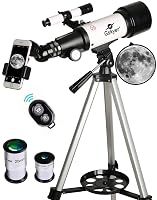 GskyerGskyer Telescope, 70mm Aperture 400mm AZ Mount Astronomical Refracting Telescope for Kids… |
8.6/10Good | Gskyer Telescope suits beginners and older children who need an adjustable full-height ground tripod rather than a tabletop stand, featuring a larger 70mm aperture, 400mm focal length, travel carry bag, phone adapter, and wireless remote for capturing lunar photos on mobile devices. View listing |
 UncleHuUncleHu Telescope for Adults Beginners,90mm Aperture 500mm Refractor,Orange |
9.6/10Excellent | High Powered serves amateur astronomers seeking substantially greater light-gathering capability, incorporating a 90mm aperture, 500mm focal length refractor tube, moon filter, custom backpack, and smartphone mounting hardware suited for both adults and older youth. View listing |
 Wosports90mm Telescope for Adults High Powered, Magnification 180X |
9.0/10Very good | 600mm Astronomy Portable Professional Refractor is geared toward viewers who require extended focal reach and higher potential magnification up to 180X, offering a 90mm objective lens, 600mm tube length, adjustable aluminum tripod, and dedicated travel storage. View listing |
Scores are out of 10, based on listed specifications and buyer feedback. Prices are the ones on the listing when this page was written.
FAQ
Can this telescope be used to view distant planets like Saturn and Jupiter?
While bright planets may appear as distinct points of light, this telescope is specifically designed for lunar observation. Its 25-diameter objective lens and Galilean eyepieces lack the light gathering and magnification necessary to resolve Saturn’s rings or Jupiter’s cloud bands in clear detail.
Does the telescope include a full-height floor tripod?
No, the unit comes equipped with a tabletop tripod designed for placement on flat, elevated surfaces such as desks, picnic tables, or sturdy benches rather than standing on the ground.
What age group is this telescope best suited for?
The manufacturer specifically designs this model for children between the ages of 8 and 12, offering straightforward assembly, manual focus controls, and a manageable tabletop profile for beginners.
Why does the moon look blurry through the eyepiece?
Blurriness usually results from viewing through a closed window, improper manual focus, or atmospheric turbulence. Opening windows to eliminate thermal distortion and slowly rotating the manual focus dial will sharpen the lunar image.
Can this telescope be used for daytime terrestrial viewing?
Yes, because the Galilean optical design naturally preserves an upright orientation without internal inverted prism inversion, the telescope can be used during daylight hours to view distant landscapes and wildlife.
Finding reliable gear for a busy household always comes down to balancing durability with everyday usability. Just as you weigh essential features over unnecessary extras when consulting our Gas Range Guide, choosing an introductory telescope requires focusing on what children can manage independently. With realistic expectations about its tabletop design, this lunar scope provides an accessible, low-stress entry point into family stargazing.
Once your young astronomer begins documenting lunar phases or snapping smartphone photos through the eyepiece, managing those digital files across family devices becomes the next consideration. Consulting our NAS Drive Guide helps you establish a central home storage hub to preserve their astronomy logs safely. This ensures their stargazing journey remains organized without filling up personal phone storage.
More Optics & Outdoors ratings
See the section
Hi-Lux M1000-PRO Rifle Scope: Streamlined Ranging for Fast Field Shots
Shooters seeking a streamlined way to engage distant targets often face a difficult choice between carrying handheld laser rangefinders or performing manual ballistic calculations…
Osmo Optic Edge Binoculars: Fast Buying Breakdown
Shoppers evaluating the Osmo Optic Edge typically want to determine whether this optical platform provides genuine high-magnification clarity or if its feature set makes…

Sogries 14×45 Binoculars: The Direct Assessment for Field Observers
Selecting high-magnification optics requires balancing image reach against field stability. The Sogries 14×45 Binoculars target observers who want substantial magnification without hauling a dedicated…

AGM NVG-50 NL1 Breakdown: Decisive Analysis for Field Use
Tactical low-light operations require immediate certainty on whether dual-tube systems resolve peripheral scanning issues without causing excessive weight fatigue or edge blur. The AGM…

Carson Red Planet RP-100 Telescope: Honest Evaluation for Beginners
The Carson Red Planet RP-100 is an entry-level Newtonian reflector engineered for stargazers who want an uncomplicated, manually operated instrument for exploring the night…
Get new ratings by email
A weekly digest of the products added to the ratings pages.