Carson Red Planet RP-100 Telescope: Honest Evaluation for Beginners
The Carson Red Planet RP-100 is an entry-level Newtonian reflector engineered for stargazers who want an uncomplicated, manually operated instrument for exploring the night sky. For busy professionals seeking an accessible introduction…
By Harold Draper 9 min read

Carson Red Planet RP-100
Carson
Good
Our score: 8.6/10
Scores are out of 10, based on listed specifications and buyer feedback.
- Specs listed
- 12
- Section
- Optics & Outdoors
Check price on Amazon We may earn a commission if you buy through this link.
As Amazon Associates, we earn from qualifying purchases. This means we may receive a small commission at no extra cost to you if you click through and make a purchase.
The Carson Red Planet RP-100 is an entry-level Newtonian reflector engineered for stargazers who want an uncomplicated, manually operated instrument for exploring the night sky. For busy professionals seeking an accessible introduction to backyard astronomy without navigating complex computerized alignment routines or fragile electronic components, this model delivers a traditional optical experience. Utilizing a 76mm primary reflecting mirror paired with a 700mm focal length, the telescope collects ample light to reveal prominent craters on the lunar terminator, the cloud bands and moons of Jupiter, and the rings of Saturn. It represents a straightforward physical instrument built around proven reflective optical principles, balancing mechanical stability with accessible magnification.
In this carson red planet telescope review, we examine the structural build, optical clarity, mounting stability, and tracking mechanics of this reflective system. We evaluate whether the included accessories provide sufficient performance out of the box, explore how the manual slow motion controls perform during actual tracking, and detail the realistic limitations of its aperture size. If you are trying to decide whether this optical assembly deserves a permanent spot in your living space or backyard, this guide provides the clarity you need to make an informed buying decision.


What You Get With the Carson Red Planet RP-100
Unboxing the Carson Red Planet RP-100 reveals a complete astronomical starter package designed to eliminate the need for immediate third-party accessory purchases before your first stargazing session.
In the box
- Carson Red Planet RP-100 76mm Newtonian reflector optical tube assembly finished in signature red
- Heavy duty aluminum tripod with adjustable legs for customized viewing heights
- Altazimuth U-mount mechanism engineered with integrated manual slow motion controls
- Kellner 20mm eyepiece providing 35x base magnification for wider celestial fields
- Kellner 9mm eyepiece delivering 78x magnification for detailed planetary observation
- 10x30mm erecting finderscope to assist with manual target centering and initial alignment
- Rack-and-pinion manual focusing barrel for fine image tuning
- Protective lens covers and mirror housing hardware
Key Specifications
A detailed review of the carson red planet rp-100 specs highlights the foundational optical ratios and physical dimensions that govern its observing potential.
| Optical Configuration | Newtonian Reflector |
|---|---|
| Aperture Diameter | 76 millimeters (3.0 inches / 7.6 centimeters) |
| Focal Length | 700 millimeters (27.6 inches) |
| Mounting System | Altazimuth U-Mount with Slow Motion Controls |
| Supplied Eyepieces | K20mm (35x) and K9mm (78x) |
| Zoom Ratio Multiplier | 78 multiplier x |
| Finderscope Specification | 10x30mm Erecting Finderscope |
| Field of View | 0.67 degrees |
| Exit Pupil Diameter | 0.97 millimeters |
| Assembled Dimensions | 61.8 inches deep by 33.8 inches wide by 33.8 inches high |
| Optical Tube Dimensions | 25.5 inches by 5.0 inches by 5.0 inches |
| Item Weight | 7.2 pounds (8.0 pounds packaged weight) |
All 32 attributes from the listing
| Eye Piece Lens Description | Standard |
|---|---|
| Mount | Altazimuth Mount |
| Focus Type | Manual Focus |
| Power Source | Manual Operation |
| Finderscope | 10x30mm (Erecting) |
| Compatible Devices | Camera Mount, Finder Scope, Eyepieces |
| Coating | Glass |
| Focal Length Description | 700 millimeters |
| Field Of View | 0.67 degrees |
| Zoom Ratio | 78 multiplier x |
| Additional Features | Slow Motion Controls, Attractive Design |
| Objective Lens Diameter | 7.6 centimeters |
| Item Dimensions D x W x H | 61.8"D x 33.8"W x 33.8"H |
| Item Weight | 7.2 pounds |
| Exit Pupil Diameter | 0.97 millimeters |
| Brand | Carson |
| Model Name | Red Planet Series |
| Global Trade Identification Number | 00750668009081 |
| Unit Count | 1 Count |
| Manufacturer | Carson |
| Number of Packs | 1 |
| UPC | 065791324834 777786217839 012303516164 666673307305 750668009081 |
| Number of Items | 1 |
| Built-In Media | Aluminum Tripod, K20mm and K9mm Eyepieces, U-mount |
| Item Type Name | Reflector Telescope |
| Model Number | Telescope |
| Manufacturer Part Number | RP-100 |
| Warranty Description | At Carson, we manufacture only the highest quality binoculars. We're so confident in our products that we back them with a No Fault, No Hassle Warranty! In the even that your binoculars get damaged, regardless of cause, Carson will repair or replace them for a total cost of $15.00, which includes all return shipping and handling fees. NO HIDDEN CHARGES! If your binoculars are found to have manufacturing defects in materials or workmanship, Carson will repair or replace your binoculars and return them FREE OF CHARGE. |
| Best Sellers Rank | #1,794 in Camera & Photo Products (See Top 100 in Camera & Photo Products) #40 in Telescope Reflectors |
| ASIN | B004P1ITN0 |
| Telescope Mount Description | Altazimuth Mount |
| Product Dimensions | 61.8"D x 33.8"W x 33.8"H |
Figures as published by the manufacturer on the Amazon listing.
Optical Performance on Lunar and Planetary Targets
The carson red planet optical performance is defined by its 76mm primary mirror, which translates to roughly three inches of light-gathering surface. When focused on the Moon, this optical arrangement produces sharp, high-contrast imagery along the terminator line where sunlight meets shadow. Mountain peaks, crater rims such as Tycho and Copernicus, and wide volcanic maria resolve with satisfying clarity. Because reflector optics bounce incoming photons rather than refracting them through thick glass lenses, color fringing along bright lunar ridges is nonexistent, making carson red planet moon viewing a genuine highlight of the system.
Planetary observation requires practical expectations regarding magnification and mirror diameter. With the included 9mm eyepiece yielding 78x magnification, the rings of Saturn are cleanly separated from the planet disk under calm atmospheric conditions. Jupiter reveals its disc along with the four primary Galilean satellites, which appear as crisp, pinpoint points of light orbiting the gas giant. The 0.97mm exit pupil at maximum magnification keeps images reasonably bright, though atmospheric turbulence will naturally limit edge sharpness on humid or windy evenings.
Where the carson rp-100 newtonian reflector encounters its natural boundary is deep-sky viewing. A 76mm mirror collects enough illumination for brighter open star clusters, the core of the Orion Nebula, and the Andromeda Galaxy, but these distant objects appear as faint gray clouds rather than detailed, colorful structures. For city and suburban dwellers contending with moderate light pollution, performance centers strictly on bright solar system objects and major double stars, which align squarely with the intended design parameters of an entry-level reflector.
Assembly and Physical Setup Workflow
The carson red planet telescope setup is straightforward enough that first-time observers can complete assembly in under thirty minutes. The aluminum tripod legs extend via locking thumb-clamps, establishing a wide, stable footprint on grass, dirt, or patio concrete. The U-shaped altazimuth mounting bracket secures directly to the tripod head, creating the cradle that holds the 25.5-inch long optical tube assembly. Because all mechanical linkages utilize manual hardware, you do not need to pack spare alkaline batteries, charging packs, or specialized tools into the yard.
Aligning the 10x30mm erecting finderscope represents an essential preparatory step for trouble-free observing. Unlike standard astronomical finders that invert the orientation, this erecting model presents an upright, correct-orientation view of terrestrial and celestial markers. Aligning the finderscope during late afternoon on a distant stationary object, such as a utility pole or tree branch, ensures that when you peer through the main eyepiece at night, centered targets in the finder appear directly within your field of view.
For individuals evaluating the carson red planet for beginners, the purely manual workflow eliminates the steep learning curve associated with modern software-driven mounts. There are no GPS coordinates to enter, no complex three-star alignment algorithms to memorize, and no internal motor drives to calibrate. You simply place the tripod on level ground, uncap the primary mirror cell, slot your preferred eyepiece into the focusing barrel, and aim manually toward your celestial target.
Tracking Objects With Altazimuth Slow Motion Controls
Because the Earth rotates continuously beneath the night sky, celestial objects drift across an eyepiece field of view surprisingly fast, especially at 78x magnification. The carson red planet slow motion controls solve this issue by providing micro-adjustment capability along both the horizontal azimuth and vertical altitude axes. Rather than nudging the long metal tube by hand, which introduces severe image jitter, you turn flexible slow-motion control cables that move the optical axis in tiny, controlled increments.
The mechanical gearing within the U-mount provides enough resistance to prevent unwanted slippage while remaining responsive to gentle turns of the control knobs. When tracking Saturn or Jupiter, keeping your fingers lightly positioned on the slow-motion dials allows you to maintain the planet within the 0.67-degree field of view smoothly. While an altazimuth mount does not follow the natural curved equatorial arc of the night sky in a single motion, alternating between the altitude and azimuth knobs quickly becomes second nature.
For those interested in automated robotic tracking rather than manual mechanical control, advanced instruments such as the unistellar odyssey pro take an entirely digital approach to target acquisition. However, the manual dials on the RP-100 provide a hands-on mechanical connection to astronomy that requires zero software updates, zero wireless connections, and zero operating system compatibility concerns.
Portability and Living Space Integration
Transporting astronomical equipment often presents an unexpected barrier for casual hobbyists, but the Carson Red Planet RP-100 remains manageable at just 7.2 pounds for the primary hardware. The entire assembly can be lifted and carried outside in one trip by grasping the tripod collar and optical tube simultaneously. For weekend road trips or camping excursions, the optical tube unbolts rapidly from the U-mount cradle, allowing the tripod to collapse down and fit alongside the tube inside a standard vehicle trunk.
A notable characteristic of the Carson Red Planet line is its aesthetic presentation. Entry-level telescopes are frequently constructed with utilitarian, unfinished gray or plain black finishes that look cluttered when left out in a room. The RP-100 features a sleek, metallic crimson tube with black anodized fittings and brushed aluminum legs. This visual design allows busy homeowners to leave the instrument assembled in a corner office, study, or living area as an attractive display piece between clear observing nights.
While our site occasionally covers unrelated terminology like our telescope lift loreal breakdown, this guide is dedicated strictly to astronomical hardware designed for sky observation. The compact 33.8-inch by 33.8-inch footprint ensures the tripod does not monopolize excessive floor space when positioned permanently near a picture window or patio door.
Carson Red Planet RP-100 Pros and Cons
Pros
- Generous 700mm focal length for planetary contrast
- Smooth slow motion controls for manual tracking
- Sturdy aluminum tripod provides stable viewing height
- Includes both 20mm and 9mm eyepieces
- Lightweight 7.2-pound optical tube assembly
Cons
- Modest 76mm aperture limits deep-sky observation
- Manual operation requires persistent adjustment
- Eyepieces provide relatively narrow field of view
Check Carson Red Planet RP-100 on Amazon
Is the Carson Red Planet RP-100 Worth It
Deciding if the carson red planet is worth it depends entirely on your personal expectations and observational goals. If you are a working professional or parent searching for the best beginner reflector telescope that provides immediate, manual exploration of the Moon and major planets, this unit delivers solid optical honesty. The optical tube length provides genuine 700mm focal reach without artificial internal barlow elements, ensuring crisp contrast on lunar topography and planetary discs.
Conversely, this instrument will not satisfy experienced observers hunting for deep-sky faint fuzzies, nebular filaments, or high-end astrophotography capabilities. Its 76mm aperture simply lacks the light-collecting power required to reveal fine detail in distant star clusters, and the manual altazimuth mount cannot track exposures over multiple seconds for long-exposure photography. Buyers desiring automated push-to navigation or deep-sky astrophotography should seek larger motorized optical setups.
For casual evening observers who want a reliable, aesthetically pleasing telescope that works immediately without technical troubleshooting, the Carson RP-100 delivers strong mechanical and optical value. It provides dependable performance for weekend sky scanning, lunar viewing sessions with family, and spontaneous checks on planetary positions.
Other Options to Consider
| Model | Our score | Why it is here |
|---|---|---|
 CarsonCarson Red Planet 35-78x76mm Newtonian Reflector Telescope (RP-100) , RedReviewed here |
8.6/10Good | The model reviewed on this page. View listing |
 GskyerGskyer Telescope, 70mm Aperture 400mm AZ Mount Astronomical Refracting Telescope for Kids… |
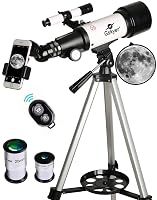
8.6/10Good | Gskyer Telescope suits travelers and younger beginners who prioritize portable refractor optics and digital accessories, featuring a 70mm aperture, a 400mm focal length, an included carry bag, a smartphone adapter, and a wireless remote. View listing |
 Blue Marble ToysNASA Lunar Telescope for Kids Ages 8-12 with Tripod and Finder Scope |
8.2/10Good | 90x Magnification is tailored specifically as a children's tabletop instrument for ages 8 to 12, offering a compact NASA lunar telescope form factor with two eyepieces and 90x magnification for younger learners. View listing |
 UncleHuUncleHu Telescope for Adults Beginners,90mm Aperture 500mm Refractor,Orange |
9.6/10Excellent | High Powered provides an alternative refractor configuration for adults seeking a slightly wider 90mm aperture with a 500mm focal length, faceted tube styling, backpack, and bundled moon filter. View listing |
Scores are out of 10, based on listed specifications and buyer feedback. Prices are the ones on the listing when this page was written.
FAQ
What celestial objects can you clearly observe with the Carson Red Planet RP-100?
The telescope is optimized for bright solar system targets. You can clearly view lunar craters, mountain peaks, and maria in striking detail. For planetary observing, the rings of Saturn, the four Galilean moons of Jupiter, and Jupiter’s primary cloud bands are visible under good seeing conditions. Bright star clusters like the Pleiades also show nicely, while distant galaxies and nebulae appear only as faint, structureless smudges.
How do the two included eyepieces differ in magnification and practical use?
The Carson RP-100 includes a 20mm Kellner eyepiece and a 9mm Kellner eyepiece. When installed in the 700mm focal length optical tube, the 20mm eyepiece delivers 35x magnification, which provides a wider field of view for finding objects and taking in full lunar views. The 9mm eyepiece provides 78x magnification, narrowing the field of view to reveal tighter planetary details on Saturn and Jupiter.
Does this Newtonian reflector require regular optical collimation?
Newtonian reflectors utilize mirrors that can shift slightly if subjected to heavy bumps or rough transportation. The Carson RP-100 features a factory-aligned primary and secondary mirror system that holds alignment well during ordinary domestic handling. While the listing does not specify specialized collimation tools in the package, casual viewing at 35x and 78x magnifications is generally forgiving of minor alignment variations.
Can a smartphone or camera be attached to this telescope?
The telescope specifications list compatibility with camera mounts, finder scopes, and eyepieces. However, the listing does not include a dedicated smartphone adapter or T-ring adapter in the box. Users wishing to capture basic lunar photos can attach third-party universal smartphone clamps to the eyepiece barrel for quick afocal photography.
Why does the finderscope show an upright image while the main telescope eyepiece is inverted?
The included 10x30mm finderscope features internal erecting optics, displaying targets right-side up to make navigation intuitive. The main optical tube is a classic Newtonian reflector, which uses a curved primary mirror and a flat diagonal secondary mirror that naturally renders the view upside down. While inverted images can feel unfamiliar for terrestrial viewing, orientation does not hinder astronomical observation in deep space.
More Optics & Outdoors ratings
See the section
Hi-Lux M1000-PRO Rifle Scope: Streamlined Ranging for Fast Field Shots
Shooters seeking a streamlined way to engage distant targets often face a difficult choice between carrying handheld laser rangefinders or performing manual ballistic calculations…
Osmo Optic Edge Binoculars: Fast Buying Breakdown
Shoppers evaluating the Osmo Optic Edge typically want to determine whether this optical platform provides genuine high-magnification clarity or if its feature set makes…

Sogries 14×45 Binoculars: The Direct Assessment for Field Observers
Selecting high-magnification optics requires balancing image reach against field stability. The Sogries 14×45 Binoculars target observers who want substantial magnification without hauling a dedicated…

AGM NVG-50 NL1 Breakdown: Decisive Analysis for Field Use
Tactical low-light operations require immediate certainty on whether dual-tube systems resolve peripheral scanning issues without causing excessive weight fatigue or edge blur. The AGM…

Lowrance Eagle 4x: The No-Nonsense Kayak Fish Finder
Finding fish from a compact paddlecraft or utility vessel requires balancing physical cockpit space against functional marine electronics. The Lowrance Eagle 4x addresses this…
Get new ratings by email
A weekly digest of the products added to the ratings pages.