Celestron NexStar 8SE Review: The Efficient Path to Deep-Sky Observing
The Celestron NexStar 8SE is designed for stargazers who want serious optical reach without spending hours manually finding faint objects. If you are debating whether to upgrade from an entry-level scope, this…
By Harold Draper 8 min read

Celestron NexStar 8SE
Celestron
Good
4.3 out of 5
Average of the Amazon buyer ratings — not a score from testing of our own
- Specs listed
- 10
- Section
- Optics & Outdoors
Check price on Amazon We may earn a commission if you buy through this link.
As Amazon Associates, we earn from qualifying purchases. This means we may receive a small commission at no extra cost to you if you click through and make a purchase.
The Celestron NexStar 8SE is designed for stargazers who want serious optical reach without spending hours manually finding faint objects. If you are debating whether to upgrade from an entry-level scope, this model directly bridges the divide between small beginner refractors and complex permanent observatory systems. By packaging a large optical aperture into an easily transported fork-arm configuration, it targets amateur astronomers who value observing efficiency and optical clarity.
In this Celestron NexStar 8SE review, we evaluate the system’s automated tracking, mechanical stability, optical limits, and day-to-day usability. We examine how the computerized GoTo platform performs during real observing sessions, what accessories you must add to keep it running smoothly, and how its visual capabilities compare to other instruments on the market so you can decide if it matches your observing goals.


What You Get With the Celestron NexStar 8SE
The telescope arrives with the essential optical and mechanical hardware required to assemble a functional motorized stargazing station, combining high-aperture catadioptric glass with digital tracking hardware.
In the box
- Celestron 8 inch Schmidt-Cassegrain optical tube assembly with iconic orange finish
- Computerized altitude-azimuth single fork arm mount and matching structural tripod
- NexStar+ hand control with an internal database of over 40,000 celestial objects
- StarPointer red dot finderscope supplied with a CR2032 lithium coin battery
- Standard 25mm visual eyepiece providing versatile low-to-medium magnification
- Integrated Celestron SkyAlign technology programming for multi-star alignment
- Accessory port compatibility for future automated or wireless expansion modules
- Two-year warranty supported by Celestron technical support based in the United States
Key Specifications
| Brand | Celestron |
|---|---|
| Model Name | NexStar 8SE Computerized Telescope |
| Optical Tube Length | 43.2 centimeters |
| Objective Lens Diameter | 20.3 centimeters (8 inches) |
| Eyepiece Included | 25mm eyepiece |
| Telescope Mount Description | Computerized Altitude-Azimuth Single Fork Arm Mount |
| Product Dimensions | 32 inches D x 34 inches W x 52 inches H |
| Focus Type | Manual Focus |
| Finderscope | StarPointer red dot finderscope (includes CR2032 battery) |
| Power Source | 8-AA batteries, 12V AC adapter, or external PowerTank (none included) |
All 36 attributes from the listing
| Eye Piece Lens Description | 25mm eyepiece |
|---|---|
| Mount | Computerized Altitude-Azimuth Single Fork Arm Mount |
| Focus Type | Manual Focus |
| Power Source | 8-AA batteries, 12v AC adapter, or any of Celestron’s PowerTank external power sources – none of which are included. See more |
| Finderscope | StarPointer™ red dot finderscope (includes 51632 with CR2032 battery) |
| Compatible Devices | Laptop, Desktop, Smartphone, GPS Device |
| Number of Batteries | 1 Lithium Metal batteries required. (included) |
| Coating | StarBright XLT |
| Focal Length Description | 2032 millimeters |
| Field Of View | 0.75 degrees |
| Dawes Limit | 0.57 arc sec |
| Zoom Ratio | 16 |
| Additional Features | Fully Automated GoTo Mount with 40,000+ Object Database |
| Optical-Tube Length | 43.2 centimeters |
| Objective Lens Diameter | 20.3 centimeters |
| Item Dimensions D x W x H | 32"D x 34"W x 52"H |
| Item Weight | 10.88 kg |
| Exit Pupil Diameter | 4.06 millimeters |
| Brand | Celestron |
| Model Name | NexStar 8SE Computerized Telescope |
| Age Range Description | Adults |
| Global Trade Identification Number | 00050234110693 |
| Item Highlight | Fully Automated GoTo Mount with SkyAlign, Large 8" SCT Optics, Visual & Astroimaging Ready, Deep-Sky & Planets, 40k+ Objects |
| Unit Count | 1 Count |
| Manufacturer | Celestron |
| UPC | 050234110693 |
| Number of Items | 1 |
| Built-In Media | 25mm eyepiece, Accessory Tray, NexStar+ Hand Control, Optical tube, Single Fork Arm Mount and Tripod, Star Diagonal, Star Pointer Finderscope |
| Model Number | 11069 |
| Manufacturer Part Number | 11069 |
| Warranty Description | 2 Years |
| Best Sellers Rank | #183 in Camera & Photo Products (See Top 100 in Camera & Photo Products) #1 in Catadioptric Telescopes |
| ASIN | B000GUFOC8 |
| Optical Tube Length | 43.2 centimeters |
| Telescope Mount Description | Computerized Altitude-Azimuth Single Fork Arm Mount |
| Product Dimensions | 32"D x 34"W x 52"H |
Figures as published by the manufacturer on the Amazon listing.
Optical Performance and Deep Sky Viewing Capabilities
Evaluating the NexStar 8SE telescope specs reveals that the heart of this system is its 20.3-centimeter objective aperture. An eight-inch catadioptric system collects substantially more light than introductory 70mm or 90mm starter scopes, which fundamentally changes what you can see through the eyepiece. The optics gather enough illumination to show intricate details along the lunar terminator, the cloud belts of Jupiter, the Cassini Division in Saturn’s rings, and subtle surface shadings on Mars during favorable oppositions.
When turning the instrument toward deep-space objects, NexStar 8SE deep sky viewing reveals bright emission nebulae, distinct spiral structures in nearby galaxies, and hundreds of individual stellar points resolved within dense globular clusters like Messier 13. The manual focus knob allows you to dial in sharp contrast at the focal plane, though like all closed Schmidt-Cassegrain designs, the optical tube requires time to equilibrate to ambient outdoor temperatures before optical sharpness reaches its full potential at high magnification.
For observers who prefer direct visual observation through glass rather than looking at digital displays, this optical tube provides authentic real-time views. While digital astrophotography smart scopes such as the unistellar odyssey pro generate processed images on a mobile screen, the Celestron system focuses on delivering genuine optical photons directly to your eye through the included 25mm eyepiece.
Alignment Setup and SkyAlign Navigation Workflow
The NexStar 8SE alignment setup relies on the included NexStar+ hand controller to manage setup routines and motorized pointing. With more than 40,000 celestial targets cataloged in its memory, the system eliminates the need to cross-reference paper star atlases during short observing windows. Once aligned, the user simply selects an object from the menu, and the motorized mount slews directly to the target.
Initial alignment is driven by proprietary Celestron SkyAlign technology, which streamlines calibration for users who do not know the technical names of stars. After leveling the tripod and inputting your date, time, and coordinates, you point the StarPointer red dot finderscope at any three bright stars or planets in the sky, centering each in the eyepiece. The internal processor cross-references the angular distances between the three points to orient the mount in minutes.
While the NexStar 8SE computerized GoTo mount is capable of reliable automated tracking, precision depends on careful mechanical leveling. The motorized single fork arm drives both axes to counter Earth’s rotation, keeping targets centered in the field of view so multiple observers can view an object without manual re-centering.
Power Requirements and Field Operation Realities
Careful attention must be paid to the NexStar 8SE power requirements before taking the telescope into the field. The product specifications list compatibility with eight internal AA batteries, an external 12-volt AC adapter, or external portable power stations, but none of these power supplies are included in the box. Operating an eight-inch motorized telescope on standard AA batteries is generally impractical, as high-speed slewing quickly drains disposable alkaline cells and can lead to erratic tracking or dropped alignments.
To ensure steady performance, field observers typically purchase a dedicated 12V DC power pack or an AC adapter for backyard use near an electrical outlet. In contrast to fully integrated smart platforms like the zwo seestar s30 pro, which comes with an internal rechargeable battery, the Celestron setup retains a modular layout that requires you to source your own external electrical feed.
In terms of physical transport, the fully assembled telescope occupies a footprint of 32 inches deep by 34 inches wide and stands 52 inches tall. However, the optical tube measures only 43.2 centimeters in length. The assembly separates quickly into three manageable parts: the optical tube, the computerized fork arm, and the tripod. This modularity allows the entire system to fit easily into the back seat or trunk of a standard vehicle for travel to dark-sky parks.
Astrophotography Potential and Mount Limitations
Evaluating the NexStar 8SE for astrophotography requires an understanding of mount mechanics. The altitude-azimuth single fork arm mount tracks targets by moving simultaneously in both horizontal and vertical steps. While this works well for keeping visual targets centered, it introduces field rotation during long photographic exposures, making unguided deep-sky exposure sequences of faint nebulae impractical without an optional equatorial wedge.
Where the telescope does perform well photographically is high-speed planetary and lunar imaging. Because planetary capture uses rapid video bursts stacked into a single sharp frame, long tracking exposures are not required. Attaching a compatible imaging sensor or smartphone adapter allows photographers to record detailed views of the Moon’s craters and the rings of Saturn through the 20.3-centimeter aperture.
Those seeking dedicated, automated long-exposure imaging of distant galaxies often look toward automated astrographs like the vespera pro telescope. For visual observers who want the versatility of an eyepiece alongside occasional planetary photography, the NexStar 8SE remains a capable optical system.
Celestron NexStar 8SE Pros and Cons
Pros
- Large 8-inch Schmidt-Cassegrain light-gathering aperture
- Computerized GoTo mount with 40,000-plus object database
- Rapid multi-star alignment with SkyAlign technology
- Compact optical tube length of 43.2 centimeters
- Two-year warranty with US-based technical support
Cons
- Power supplies and batteries not included in box
- Manual focus requires hands-on optical adjustment
- Single fork arm mount limits deep-sky astrophotography
Check Celestron NexStar 8SE on Amazon
Is the Celestron NexStar 8SE Worth It
Deciding if the Celestron NexStar 8SE is worth it comes down to balancing optical power against setup requirements. For intermediate observers, dedicated amateur astronomers, and professionals with limited free time, this telescope provides an efficient way to locate and observe deep-sky objects. The eight-inch aperture collects enough light to reveal meaningful detail on planets and distant star clusters, turning short viewing sessions into rewarding experiences.
Conversely, this telescope is less suitable for casual hobbyists who want an ultra-lightweight travel scope or those who expect an out-of-the-box astrophotography rig. The need to supply external 12V power, learn SkyAlign calibration, and manage an assembled weight across multiple components demands commitment before achieving smooth field operation.
If you want serious visual performance combined with an automated GoTo system that eliminates manual star hopping, the NexStar 8SE stands as a dependable, highly expandable platform supported by a two-year manufacturer warranty.
Other Options to Consider
| Model | Buyer rating | Ratings | Why it is here |
|---|---|---|---|
 CelestronCelestron NexStar 8SE Computerized Telescope – Schmidt-CassegrainReviewed here CelestronCelestron NexStar 8SE Computerized Telescope – Schmidt-CassegrainReviewed here |
4.3Good | — | The model reviewed on this page. View listing |
 GskyerGskyer Telescope, 70mm Aperture 400mm AZ Mount Astronomical Refracting Telescope for Kids… GskyerGskyer Telescope, 70mm Aperture 400mm AZ Mount Astronomical Refracting Telescope for Kids… |
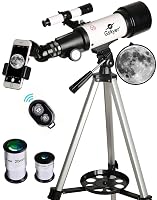
4.3Good | — | The Gskyer Telescope suits budget-conscious beginners and children who need a lightweight grab-and-go setup. Featuring a 70mm aperture, a 400mm focal length manual alt-azimuth mount, a carry bag, smartphone adapter, and wireless remote, it provides a simple refractor experience without computerized motors or external power requirements. View listing |
 Blue Marble ToysNASA Lunar Telescope for Kids Ages 8-12 with Tripod and Finder Scope Blue Marble ToysNASA Lunar Telescope for Kids Ages 8-12 with Tripod and Finder Scope |
4.1Good | 6,978 | The 90x Magnification telescope serves young children and families looking for an introductory lunar viewing toy. Designed as a NASA lunar telescope for kids aged 8 to 12, it includes two eyepieces, a tabletop tripod, and a finder scope for straightforward, stationary viewing of the Moon. View listing |
 UncleHuUncleHu Telescope for Adults Beginners,90mm Aperture 500mm Refractor,Orange UncleHuUncleHu Telescope for Adults Beginners,90mm Aperture 500mm Refractor,Orange |
4.8Excellent | — | The High Powered telescope appeals to adult beginners seeking a manual refractor package with dedicated travel accessories. Equipped with a 90mm aperture, a 500mm focal length, an orange faceted optical tube, an adjustable tripod, a backpack, and a moon filter, it offers an accessible manual alternative for terrestrial and introductory celestial viewing. View listing |
Ratings are the star averages left by Amazon buyers, not scores from our own testing. Prices are the ones on the listing when this page was written.
FAQ
What power source should I use with the Celestron NexStar 8SE?
Although the mount accepts eight AA batteries, they deplete quickly during motorized tracking and slewing. To prevent unexpected tracking errors or mid-session shutdowns, Celestron recommends using an external 12-volt AC adapter near home outlets or a dedicated portable 12-volt power bank in the field. Neither is included in the base package.
Can I use the NexStar 8SE for deep space astrophotography?
The NexStar 8SE is primarily built for visual astronomy and short-exposure planetary imaging. Because its computerized single fork arm utilizes an altitude-azimuth tracking movement, long photographic exposures will show field rotation. Capturing faint deep-sky nebulae and distant galaxies typically requires an equatorial mount or an optional equatorial wedge.
How does Celestron SkyAlign technology work?
SkyAlign allows you to align the computerized GoTo system without needing to know the names of the stars in the night sky. After leveling the tripod and inputting time and location data into the NexStar+ hand control, you center any three bright celestial objects using the StarPointer red dot finderscope and eyepiece. The internal processor calculates the telescope’s orientation and readies the 40,000-object database.
What accessories are included in the box?
The telescope package includes the 8-inch Schmidt-Cassegrain optical tube assembly, the computerized single fork arm mount, a structural tripod, a NexStar+ hand controller, a 25mm eyepiece, and a StarPointer red dot finderscope with a CR2032 battery. Power adapters, AA batteries, and extra eyepieces must be acquired separately.
What can you see with the 8-inch Schmidt-Cassegrain aperture?
The 20.3-centimeter aperture gathers ample light to reveal lunar craters, Jupiter’s atmospheric cloud bands, the Great Red Spot, and Saturn’s ring system. Under dark skies away from light pollution, it resolves bright Messier objects including the Orion Nebula, the Andromeda Galaxy core, and globular clusters like M13 into individual stars.
More Optics & Outdoors ratings
See the section
Pentax Papilio II 6.5×21 Binoculars: Executive Field Review
Field professionals, naturalists, and outdoor enthusiasts seeking a dual-purpose optical tool often ask whether an optic can genuinely serve as both a field microscope…
Buyer favourite 4.5+ stars from 500 or more ratings

Kyosho Mini-Z MR-04 Battery Remover and Stand: Fast Pit Essential
Racers running the modern Kyosho micro platform often struggle with tight battery fitment, making the Rocket Pups Mini-Z MR-04 Battery Tool a valuable addition…

Vortex Triumph HD 10×42 Binoculars: The Decisive Outdoor Verdict
For outdoor enthusiasts, hunters, and wildlife observers searching for an uncompromising entry-level full-size optic, the Vortex Triumph HD 10×42 provides an accessible balance of…
Buyer favourite 4.5+ stars from 500 or more ratings

Nikon Prostaff P3 8×42: Direct Optical Assessment for Busy Fieldwork
Deciding on a reliable piece of field optics requires cutting through marketing jargon and evaluating optical physics, mechanical build, and real-world utility. The Nikon…
Buyer favourite 4.5+ stars from 500 or more ratings

Vortex Razor HD Gen II-E Review: Benchmark LPVO Performance
Selecting an optical setup for short- to medium-range shooting requires an uncompromising balance between split-second target acquisition and long-range visual clarity. The Vortex Razor…
Get new ratings by email
A weekly digest of the products added to the ratings pages.