Sony NEX-3: Quick Buying Verdict for Busy Creators
Busy professionals and content creators seeking an ultra-compact interchangeable lens system often evaluate early mirrorless cameras to balance physical footprint against optical capability. The Sony NEX-3 was engineered to provide the image…
By Brian Carver 8 min read

Sony NEX-3
Sony
Very good
Our score: 8.8/10
Scores are out of 10, based on listed specifications and buyer feedback.
- Specs listed
- 10
- Section
- Cameras & Drones
Check price on Amazon We may earn a commission if you buy through this link.
As Amazon Associates, we earn from qualifying purchases. This means we may receive a small commission at no extra cost to you if you click through and make a purchase.
Busy professionals and content creators seeking an ultra-compact interchangeable lens system often evaluate early mirrorless cameras to balance physical footprint against optical capability. The Sony NEX-3 was engineered to provide the image quality of a traditional DSLR inside a package roughly half the size and weight. If you are deciding whether this setup meets modern daily demands, this Sony NEX-3 review clarifies how its hardware translates into practical performance for everyday tasks, field documentation, and creative shooting.
In this guide, we evaluate the core engineering of the Sony NEX-3 mirrorless camera to help you determine if it fits your specific workflow. We examine the camera’s APS-C imaging sensor, continuous shooting speed, low light behavior, and overall ergonomics with the bundled zoom optic. The sections below analyze real-world handling, provide a detailed specifications breakdown, contrast this model against alternative recording tools, and deliver a definitive verdict for buyers prioritizing efficiency.
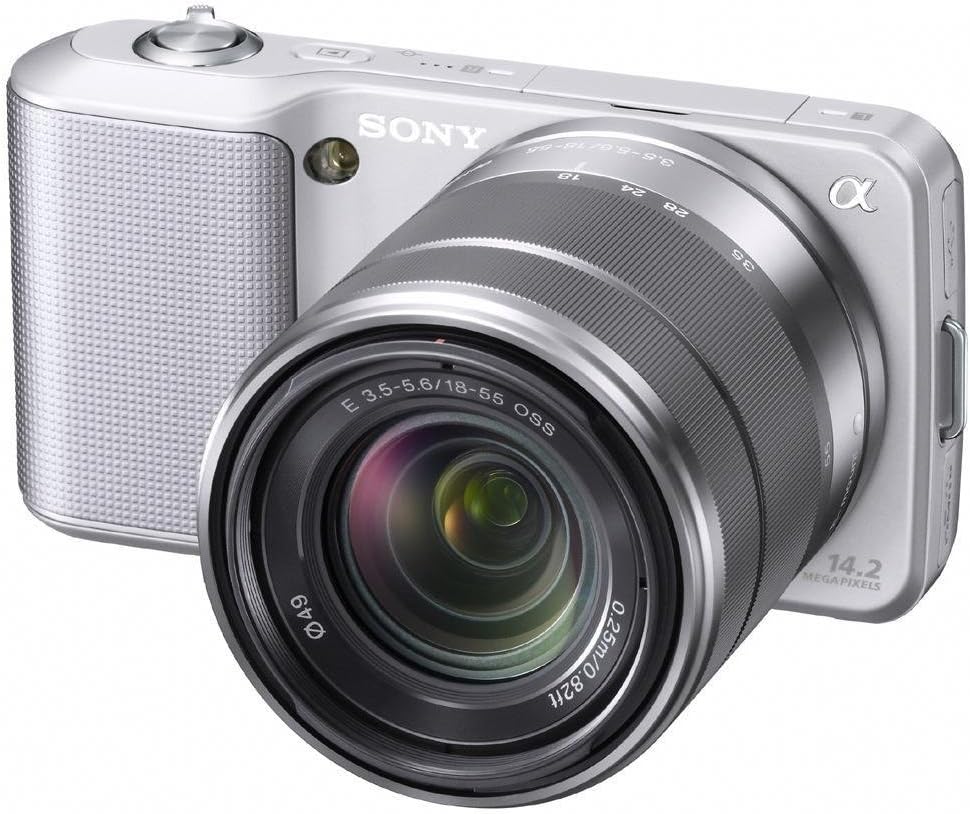


What You Get With the Sony NEX-3
The Sony NEX-3 package pairs an ultra-compact mirrorless chassis with an everyday zoom optic to deliver a versatile shooting kit right out of the box.
In the box
- Sony NEX-3 mirrorless camera body in silver finish
- Sony E-mount 18-55mm zoom lens with a maximum f/3.5 aperture
- 14.2 megapixel APS-C CMOS sensor
- Tilting 3-inch LCD display with Live View framing
- Digital image stabilization system
- Scene selection shooting modes and Sweep Panorama capture
- Support for Sony E and Sony FE lens mountings
- MP4 video recording capability
Key Specifications
| Sensor Type and Dimensions | APS-C CMOS (23.4 x 15.6 mm) |
|---|---|
| Effective Still Resolution | 14.2 Megapixels |
| Lens Mount Compatibility | Sony E (NEX), Sony FE |
| Lens Included | 18-55mm (Maximum Aperture f/3.5) |
| Shutter Speed Range | 1/4000 to 30 seconds |
| Continuous Shooting Speed | Up to 7 frames per second |
| ISO Sensitivity Range | Expanded minimum ISO 200 up to ISO 12800 |
| Display Screen | 3-inch tilting LCD with Live View |
| Video Format | MP4 HD video capture |
| Exposure System | Automatic exposure control with Scene modes |
All 80 attributes from the listing
| Compatible Mountings | Sony E (NEX), Sony FE |
|---|---|
| Aspect Ratio | 1.33:1 |
| Sensor Type | CMOS |
| File Format | MP4 |
| Image stabilization | Digital |
| Maximum Aperture | 3.5 f stop |
| Expanded ISO Minimum | 200 |
| Photo Sensor Resolution | 14.2 mp |
| Photo Sensor Size | APS-C (23.4 x 15.6 mm) |
| Maximum Shutter Speed | 1/4000 seconds |
| Minimum Shutter Speed | 30 seconds |
| Exposure Control | Automatic |
| Form Factor | Mirrorless |
| Effective Still Resolution | 14.2 |
| Special Feature | Image Stabilization |
| Color | Silver |
| Screen Size | 3 inches |
| Shooting Modes | Scene |
| Item Weight | 10.4 ounces |
| Video Resolution | 720p |
| Viewfinder | fixed LCD |
| Flash Modes | Panorama |
| Camera Flash | Built-In |
| Skill Level | Professional |
| Continuous Shooting | 7 frames per second |
| Flash Sync Speed | 1/160 sec |
| Video Capture Format | AVC, AVCHD, MPEG-4 |
| Expanded ISO Maximum | 12800 |
| Battery Weight | 1 g |
| Battery Cell Type | Lithium Ion |
| Connectivity Technology | HDMI, USB |
| Wireless Technology | EyeFi |
| Total USB Ports | 1 |
| Total Video Out Ports | 2 |
| Total USB 2.0 Ports | 1 |
| Hardware Interface | AV Port |
| HDMI Type | Type C Mini HDMI |
| Image Capture Type | Stills |
| Auto Focus Technology | Continuous, Contrast Detection, Live View, Multi-area, Selective single-point, Single |
| Focus Features | Contrast Detection |
| Autofocus Points | 25 |
| Focus Type | Automatic with Manual |
| Focus Mode | Continuous-Servo AF (AF-C) |
| JPEG Quality Level | Normal |
| Total Still Resolution | 14 mp |
| Maximum Image Size | 4592 pixels |
| Maximum Focal Length | 5.5 centimeters |
| Optical Zoom | 3.1 x |
| Lens Type | zoom |
| Zoom | Optical |
| Camera Lens | Standard Zoom Lens |
| Minimum Focal Length | 18 millimeters |
| Focal Length Description | 18-55 Millimeters |
| Photo Filter Thread Size | 49 millimeters |
| Metering Methods | Multi, Center-weighted, Spot |
| White Balance Settings | Auto |
| Brand | Sony |
| Model Name | ALPHA NEX-3 |
| Built-In Media | Tripod |
| Model Number | NEX3K/S |
| Model Series | NEX |
| Series Number | 3 |
| Global Trade Identification Number | 00027242797628 |
| UPC | 027242797628 610074543015 |
| Manufacturer | Sony |
| Manufacturer Part Number | NEX3K/S |
| Warranty Description | 1 YEAR LIMITED |
| Best Sellers Rank | #480,527 in Electronics (See Top 100 in Electronics) #4,071 in Digital Point & Shoot Cameras |
| ASIN | B003MPOMI6 |
| Display Type | LCD |
| Display Fixture Type | Tilting |
| Display Resolution Maximum | 920,000 |
| Flash Memory Type | SD/ SDHC/SDXC, Memory Stick Pro Duo/ Pro-HG Duo |
| Memory Storage Capacity | 2 TB |
| Flash Memory Bus Interface Type | SD |
| Compatible Flash Memory Type | SD |
| Photo Sensor Technology | CMOS |
| Supported File Format | MP4 |
| Image Stabilization | Digital |
| Metering Description | Multi, Center-weighted, Spot |
Figures as published by the manufacturer on the Amazon listing.
APS-C Sensor Architecture and Everyday Image Quality
Sensor size remains the primary foundation of photographic fidelity, and the Sony NEX-3 APS-C sensor measures 23.4 by 15.6 millimeters. This matches the physical surface area and resolution found in traditional Alpha DSLRs, granting a distinct optical advantage over standard small-sensor pocket cameras. With 14.2 megapixels of resolution, the CMOS chip captures detailed still frames that preserve subject definition when viewed on high-resolution displays. For creators documenting physical installations or visual assets for commercial presentations, Sony NEX-3 image quality delivers clean background separation thanks to the natural optical depth of field provided by the large sensor.
Paired with the versatile Sony NEX-3 18-55mm lens, the system delivers focal flexibility ranging from wide-angle perspectives to moderate portrait reach. The optic features a maximum aperture of f/3.5 at its wide end, allowing adequate light transmission for indoor product captures and environmental portraits. While newer flagship systems such as those explored in our Sony Cinema Line FX30 review provide specialized cinema sensors, the NEX-3 focuses on accessible photographic capture. The native 1.33:1 aspect ratio option and standard framing choices allow users to compose clean compositions suited for immediate documentation without cumbersome post-processing.
The CMOS architecture renders subtle color gradations and textural nuances effectively in balanced ambient lighting. Because the internal hardware relies on automatic exposure control alongside dedicated scene modes, users achieve consistent exposures across shifting environmental conditions. The 14.2 megapixel resolution strikes a practical balance between file manageability and visual sharpness, generating MP4 video files and still images that do not strain storage capacity or slow down file transfers during active operational schedules.
Burst Rate and Motion Tracking Capabilities
Action documentation demands dependable response times, and the Sony NEX-3 burst rate reaches up to 7 frames per second. This continuous capture speed allows users to track moving subjects, rapid workplace demonstrations, or dynamic field scenarios with minimal frame gaps. Combined with a maximum shutter speed of 1/4000 second, the camera effectively freezes fast mechanical actions and outdoor motion without introducing severe motion blur or requiring complex manual shutter calculations.
The automatic exposure mechanisms adjust dynamically between frames, helping maintain uniform exposure across rapid bursts. Whether capturing sequential phases of an industrial process or documenting candid street scenes, the high-speed continuous mode operates reliably through the mechanical shutter assembly. Evaluating the official Sony NEX-3 specs reveals that the shutter assembly spans from 1/4000 second down to 30 seconds, giving creators substantial flexibility across varied motion environments. For creators who frequently evaluate updated iterations like the model detailed in our Sony NEX-3N guide, the original NEX-3 established the benchmark for compact high-speed shooting in mirrorless bodies.
Capturing 7 frames per second produces a steady stream of image data that is committed to storage. Because the NEX-3 prioritizes efficient operation, creators can review sequences promptly on the Live View display. The mechanical shutter range down to 30 seconds also provides the opposite capability, giving users the tools to handle long-exposure tripod work when documenting night architecture or stationary machinery.
Low Light Performance and Exposure Flexibility
Challenging lighting scenarios present major hurdles for visual documentation, making the Sony NEX-3 low light performance an essential consideration for field operators. The camera provides an expanded sensitivity range stretching from ISO 200 up to ISO 12800. This wide threshold allows the 14.2 MP CMOS sensor to gather usable exposures in poorly illuminated rooms, dim warehouses, or evening outdoor assignments without relying exclusively on artificial flash units.
Because the NEX-3 utilizes an authentic APS-C sensor format, individual pixels are substantially larger than those on typical pocket compacts. This physical scale captures more photons per photosite, preserving cleaner shadow gradients at moderate ISO values. While compact point-and-shoots such as the camera examined in our Sony DSC-WX350 review offer extreme zoom convenience, the larger sensor dimensions of the NEX-3 provide better signal-to-noise control when illumination levels fall.
The NEX-3 incorporates digital image stabilization to counteract hand tremor during handheld shooting. When operating at slow shutter speeds near the 30-second boundary or shooting in low ambient light at f/3.5, stabilization helps steady the composition. However, because the stabilization is digital rather than mechanical sensor-shift, pairing the camera with a sturdy surface or tripod remains the best practice for capturing critical architectural details in low ambient light.
Portability and Practicality for Travel
The Sony NEX-3 was engineered to eliminate the bulk of traditional SLR equipment, presenting itself as the world’s smallest interchangeable lens camera at its release. By removing the traditional mirror box and optical pentaprism, Sony reduced the chassis volume to roughly half the size and weight of contemporary Alpha DSLRs. This ultra-compact profile makes the Sony NEX-3 for travel an attractive option for traveling professionals who need professional-grade optics without excessive luggage bulk.
Framing flexibility is anchored by the 3-inch tilting LCD screen equipped with Live View technology. The screen articulates upward and downward, enabling creators to capture high-angle crowds or low-angle product perspectives without awkward physical maneuvering. The Live View interface displays exposure adjustments and scene modes in real time, streamlining composition for users working in fast-moving commercial environments.
The camera body supports both Sony E (NEX) and Sony FE mountings, allowing creators to utilize an expansive library of dedicated lenses beyond the included 18-55mm optic. When expansive vistas or wide interior installations require documentation, the integrated Sweep Panorama mode automatically captures and stitches continuous panoramic images. This eliminates the requirement for complex multi-shot stitching software on a computer, delivering finished wide-angle panoramas immediately.
Sony NEX-3 Pros and Cons
Pros
- 2 MP APS-C CMOS sensor
- Continuous shooting up to 7 fps
- Tilting 3-inch LCD with Live View
- Compact mirrorless body with 18-55mm lens
- Sweep Panorama shooting mode
Cons
- Digital instead of optical stabilization
- Automatic exposure control focus
- Video recording limited to MP4 HD format
Is the Sony NEX-3 Worth It
Determining whether the Sony NEX-3 is worth it depends on the balance between your need for physical portability and your imaging requirements. If you demand a featherweight camera body that accepts interchangeable glass, houses an authentic APS-C sensor, and achieves 7 fps continuous bursts, this camera remains a remarkably capable platform for basic documentation, web media production, and field photography.
Professionals who want a simple, portable backup camera for site visits or creators who prefer physical lenses over smartphone ergonomics will appreciate the NEX-3. Its straightforward scene modes, automated exposure handling, and tilting 3-inch LCD offer an intuitive shooting experience without requiring extensive camera setup or technical adjustments.
Creators who require advanced manual video configurations, 4K recording, or mechanical in-body sensor stabilization may find the NEX-3 restrictive. The camera is tailored primarily toward still photography and straightforward MP4 video capture, meaning advanced videographers will want more dedicated production tools.
Other Options to Consider
| Model | Our score | Why it is here |
|---|---|---|
 SonySony Alpha NEX-3 Interchangeable Lens Digital Camera w/18-55mm Lens (Silver)- 14.2 MpixReviewed here |
8.8/10Very good | The model reviewed on this page. View listing |
 TapoTapo 1080P Indoor Security Camera, Baby Monitor, Dog Camera, Wired, C100 |
8.8/10Very good | Motion Detection suits users who need automated surveillance, remote pet monitoring, or dedicated home security rather than a handheld photographic tool. With 1080p indoor video, two-way audio, integrated siren, night vision, cloud and SD card storage, and smart assistant integration, it offers dedicated remote monitoring capabilities that a standalone mirrorless camera cannot provide. View listing |
 KodakKODAK PIXPRO FZ55 16MP Compact Digital Camera, 5X Optical Zoom, Black |
8.8/10Very good | 1080p Full HD Video appeals to travelers and everyday vloggers who prioritize extreme pocketability over interchangeable lenses. Featuring a 16-megapixel sensor, 5x optical zoom, a 28mm wide-angle lens, and a 2.7-inch LCD, this point-and-shoot eliminates lens management entirely for quick everyday snapshots. View listing |
 CanonCanon EOS Rebel T7 DSLR Camera EF-S 18-55mm f/3.5-5.6 is II Lens… |
9.2/10Very good | 24.1 Megapixel CMOS serves beginner photographers who prefer a traditional DSLR form factor with an optical viewfinder. Built with a 24.1-megapixel APS-C sensor, an EF-S 18-55mm image-stabilized lens kit, Full HD video capabilities, and built-in Wi-Fi, it suits users who want higher native still resolution and classical DSLR handling rather than an ultra-compact mirrorless body. View listing |
Scores are out of 10, based on listed specifications and buyer feedback. Prices are the ones on the listing when this page was written.
FAQ
Does the Sony NEX-3 support interchangeable lenses?
Yes, the Sony NEX-3 features an interchangeable lens system that is compatible with Sony E (NEX) and Sony FE mountings, and the standard package includes an 18-55mm f/3.5 zoom lens.
What sensor size is used in the Sony NEX-3?
The Sony NEX-3 utilizes an APS-C CMOS sensor measuring 23.4 by 15.6 millimeters with a 14.2 megapixel resolution, matching the physical sensor dimensions found in Alpha DSLRs.
How fast can the Sony NEX-3 shoot in continuous mode?
The camera achieves a burst rate of up to 7 frames per second, allowing creators to capture rapid action sequences and moving subjects effectively.
Does the Sony NEX-3 feature a tilting display screen?
Yes, the camera includes a 3-inch tilting LCD monitor with Live View framing, allowing you to compose shots comfortably from high and low shooting angles.
What video recording format does the Sony NEX-3 use?
The Sony NEX-3 records video in the MP4 format, providing compact file sizes suitable for straightforward digital viewing and sharing.
More Cameras & Drones ratings
See the section
Olympus LI-50B Battery: Decisive OEM Replacement Guide
When bringing a legacy compact camera back into active service, securing an authentic Olympus LI-50B battery pack provides immediate peace of mind. Sourcing an…

Olympus Stylus Tough 8010: Essential Rugged Camera Analysis
Evaluating whether a dedicated compact camera belongs on a modern job site requires looking past touchscreens and wireless gimmicks to focus strictly on physical…

GoPro Media Mod for HERO10: The Quick Professional Verdict
When planning to build a compact video rig, creators often ask whether adding the GoPro Media Mod is the right move for their workflow.…
Buyer favourite Scored 9.0+/10

Canon PowerShot S110 Review: Pocket-Sized Pro Imaging
When selecting a portable camera that balances manual control with true pocket convenience, the Canon PowerShot S110 remains a compelling tool for mobile visual…

DJI Osmo Action 6 Review: Decisive Buying Advice for Creators
Choosing a flagship action camera for fast-paced video production requires cutting through marketing noise to examine core capture hardware. The DJI Osmo Action 6…
Get new ratings by email
A weekly digest of the products added to the ratings pages.