Samsung Odyssey Neo G9 Monitor: Executive Buying Guide
The Samsung Odyssey Neo G9 57 is engineered for professionals and power users who want the workspace of two 32-inch 4K monitors combined into a single, continuous display. Featuring a native resolution…
By Zachary Chapman 10 min read

Samsung Odyssey Neo G9 57
Samsung
Very good
4.4 out of 5
Average of the Amazon buyer ratings — not a score from testing of our own
- Specs listed
- 12
- Section
- Monitors
Check price on Amazon We may earn a commission if you buy through this link.
As Amazon Associates, we earn from qualifying purchases. This means we may receive a small commission at no extra cost to you if you click through and make a purchase.
The Samsung Odyssey Neo G9 57 is engineered for professionals and power users who want the workspace of two 32-inch 4K monitors combined into a single, continuous display. Featuring a native resolution of 7680 by 2160 pixels across an expansive 32:9 aspect ratio, this display eliminates the visual disruption of center bezels for timeline editing, complex financial dashboards, data analysis, and immersive simulation. However, adopting this dual UHD curved gaming monitor requires careful evaluation of whether your desk footprint and graphics infrastructure can support its massive 52.3-inch width, 41.9-pound physical weight, and demanding pixel pipeline.
This executive buying guide evaluates the practical workstation utility, display architecture, and hardware realities of Samsung’s flagship curved panel. We examine the physical desktop requirements for its 1000R curvature, the graphics card capabilities needed to drive DisplayPort 2.1 at 240Hz, the contrast control provided by 2,392 Quantum Mini LED local dimming zones, and multi-source workflows using Picture-by-Picture. The goal is to provide a direct assessment of whether this high-performance display justifies its space and power requirements for your daily workflow.



What You Get With the Samsung Odyssey Neo G9 57
The Samsung Odyssey Neo G9 57 delivers an all-in-one panoramic workspace designed to replace multi-display arrays with a single high-bandwidth panel. The listing specifies the following integrated features and hardware components:
In the box
- 57-inch curved display delivering Dual UHD resolution at 7680 by 2160 pixels across an ultra-wide 32:9 aspect ratio.
- Deep 1000R curvature engineered to match the natural field of view and maintain edge-to-edge peripheral visibility.
- Quantum Matrix Technology powered by Quantum Mini LEDs with 2,392 local dimming zones and 12-bit black level control.
- VESA DisplayHDR 1000 certification with 1,000-nit peak brightness and a 1,000,000:1 dynamic contrast ratio.
- 240Hz refresh rate combined with a 1 millisecond gray-to-gray response time for blur-free motion precision.
- Next-generation DisplayPort 2.1 and HDMI 2.1 connectivity inputs supporting variable refresh rates and AMD FreeSync Premium Pro.
- Picture-by-Picture and Picture-in-Picture modes allowing simultaneous native viewing from two separate computing sources.
- Integrated USB Hub and Auto Source Switch+ for automatic signal switching and connected peripheral management.
- Ergonomic stand supporting height adjustment, swivel, tilt, and standard VESA mounting arm compatibility.
- CoreSync and Core Lighting+ rear lighting system that projects on-screen colors onto the surrounding workstation environment.
Key Specifications
| Screen Size and Curvature | 57 inches, 1000R Curve |
|---|---|
| Display Resolution | Dual 4K UHD (7680 x 2160 pixels) |
| Aspect Ratio | 32:9 |
| Panel Technology | VA LED with Quantum Mini LED Local Dimming |
| Refresh Rate | 240Hz |
| Response Time | 1ms (GTG) |
| Local Dimming Zones | 2,392 zones (Quantum Matrix Technology) |
| Brightness and HDR | 420 cd/m² typical, 1,000 nit peak (VESA DisplayHDR 1000) |
| Contrast Ratio | 1,000,000:1 |
| Color Gamut and Finish | 99%, Matte Screen Finish |
| Physical Dimensions and Weight | 52.3" W x 19.7" D x 24" H, 41.9 lbs (with stand) |
| Power Consumption | 140 watts |
All 45 attributes from the listing
| Aspect Ratio | 32:9 |
|---|---|
| Screen Finish | Matte |
| Contrast Ratio | 1,000,000:1 |
| Refresh Rate | 240 hertz |
| Display Type | LED |
| Display Technology | VA |
| Viewing Angle | 178 degrees |
| Brightness | 420 cd |
| Pixel Pitch | 0.18 |
| Color Gamut | 99 |
| Picture Quality Enhancement Technology | Quantum Matrix Technology, DisplayHDR 1000 |
| Screen Size | 57 inches |
| Item Dimensions D x W x H | 19.7"D x 52.3"W x 24"H |
| Item Weight | 41.9 pounds |
| Resolution | Dual 4K |
| Display Resolution Maximum | 7680 x 2160 pixels |
| Native Resolution | 7680×2160 |
| Power Consumption | 140 watts |
| Voltage | 240 volts |
| Connectivity Technology | HDMI |
| Hardware Connectivity | DisplayPort, HDMI, USB |
| Adaptive Sync | FreeSync Premium |
| Additional Features | 1000R Curved Screen, AMD FreeSync™ Premium Pro, Auto Source Switch+, Black Equalizer, Eye Care, Flicker-Free, FreeSync, Picture By Picture, Quantum Matrix Technology, VESA DisplayHDR 1000 |
| Specific Uses For Product | Gaming |
| Color | Black & White |
| Mounting Type | VESA Mount |
| Compatible Devices | Desktop, Gaming Console, Laptop |
| Warranty Type | 1 Year Manufacturer Warranty |
| Shape | Curved |
| Brand | Samsung |
| Model Number | FBASAMLS57CG952 |
| Model Name | FBASAMLS57CG952 |
| Warranty Description | 1 Year Manufacturer |
| UPC | 887276756738 |
| Manufacturer | Samsung |
| Unit Count | 1 Count |
| Included Components | DisplayPort Cable, HDMI Cable, Power Cable, USB Cable |
| Best Sellers Rank | #9,048 in Electronics (See Top 100 in Electronics) #327 in Computer Monitors |
| ASIN | B0CDQM55C9 |
| Response Time | 1 milliseconds |
| Total Number of HDMI Ports | 3 |
| Total Usb Ports | 2 |
| Number of Component Outputs | 3 |
| Total USB 2.0 Ports | 2 |
| Screen Surface Description | Matte |
Figures as published by the manufacturer on the Amazon listing.
Physical Demands of the Odyssey Neo G9 Desk Setup
Planning a stable odyssey neo g9 desk setup requires recognizing that this display functions more like a piece of architectural office furniture than a standard computer monitor. Measuring 52.3 inches in width and requiring 19.7 inches of depth with the stock stand, it occupies a substantial portion of any executive workstation. The deep 1000R curve brings the outer edges of the screen forward to maintain optical alignment with your eyes, but this forward curvature pushes the center of the display toward your seating position. Placing this unit on a shallow desk measuring less than 30 inches deep leaves inadequate room for a keyboard, mouse, and reference documents.
Weight distribution is an equally vital structural concern. At 41.9 pounds including the factory stand, the assembly places significant localized mass on desktop materials. Users with lightweight composite or hollow-core desks risk structural sagging or surface indentations over time. While the monitor is compatible with VESA mounting standards, standard articulated monitor arms cannot hold a display of this weight and width without drooping. Deploying this panel on an aftermarket arm requires an industrial-grade, heavy-duty mount engineered specifically for ultra-heavy curved displays, as detailed in our samsung 57 odyssey neo g9 g95nc architectural overview.
The included ergonomic stand provides height adjustment, tilt, and swivel capabilities, allowing you to position the massive screen for comfortable posture. However, moving a 42-pound display requires two hands and steady pressure, making micro-adjustments deliberate rather than effortless. Cable management must also be addressed carefully. With a rated power draw of 140 watts alongside thick DisplayPort 2.1 and HDMI 2.1 cables, running connections cleanly through under-desk cable raceways is essential to avoid desktop clutter.
GPU Bandwidth and Odyssey Neo G9 Hardware Requirements
Understanding the strict odyssey neo g9 hardware requirements is critical before integrating this monitor into your computing pipeline. Driving a native resolution of 7680 by 2160 pixels means pushing approximately 16.6 million pixels per frame, which is exactly double the pixel load of a standard 3840 by 2160 UHD panel. For general productivity, word processing, and multi-window web applications, modern professional graphics cards can render the desktop smoothly. However, demanding 3D modeling, high-resolution video timelines, and simulation tasks place immense computational pressure on your graphics subsystem.
Unlocking the full potential of the display requires leveraging the odyssey neo g9 displayport 2.1 input. DisplayPort 2.1 provides the expanded transmission bandwidth needed to transmit native Dual UHD resolution at the maximum 240Hz refresh rate. While the monitor also includes HDMI 2.1 ports, many workstation laptops and previous-generation graphics cards rely on DisplayPort 1.4. Connecting through an older port forces bandwidth compromises, such as capping the refresh rate at 60Hz or 120Hz at native resolution, or dropping below native Dual UHD resolution to achieve higher refresh speeds.
Motion stability across this massive canvas is stabilized by AMD FreeSync Premium Pro, which eliminates screen tearing and micro-stuttering without introducing display lag. In fast-moving simulation environments or high-frame-rate rendering previews, variable refresh rate synchronization ensures that visual transitions remain fluid across the entire field of view. Buyers should inspect their GPU port specifications carefully, verifying whether their hardware supports DisplayPort 2.1 or high-bandwidth HDMI 2.1 before expecting uncompressed 240Hz Dual UHD output right out of the box.
Visual Precision and Quantum Matrix Panel Performance
The display panel on the samsung g95nc gaming monitor uses Samsung’s Quantum Matrix Technology, pairing an LED-backlit VA panel with Quantum Mini LEDs. The backlighting array is divided into 2,392 individual local dimming zones, giving the display granular control over localized brightness. By illuminating only the precise areas required for active image elements, the panel achieves deep 12-bit black levels while mitigating the gray backlight haze and haloing effects typical of conventional edge-lit ultrawide monitors.
Visual fidelity is reinforced by VESA DisplayHDR 1000 certification, which delivers a peak brightness level of 1,000 nits and an exceptional dynamic contrast ratio of 1,000,000:1. Typical sustained full-screen brightness sits at 420 cd/m², providing ample luminance for daylit corporate offices and creative production suites. Combined with 99 percent color gamut coverage, this high dynamic range capability allows video editors, CAD designers, and analysts to identify fine visual details and subtle gradations that lower-tier panels wash out.
A major design strength for workplace usability is the matte screen finish. A curved display spanning over four feet wide is naturally prone to catching reflections from ceiling lights, desk lamps, and nearby windows. The matte coating disperses incoming light across the surface, maintaining text readability and image contrast across the full 178-degree viewing angle. For added aesthetic cohesion, the rear chassis includes CoreSync and Core Lighting+ ambient systems, which project ambient colors onto the back wall to mirror on-screen action and reduce eye strain in low-light office environments.
Optimizing the Odyssey Neo G9 Monitor for Productivity
Reviewing the odyssey neo g9 monitor for productivity demonstrates clear advantages for professionals managing fragmented workflows. Replacing two individual 32-inch 4K displays with a single continuous 32:9 panel eliminates the vertical bezel seam directly in front of the user. Software engineers can position multiple IDE columns, terminal windows, and debugging tools across an uninterrupted horizontal span. Similarly, video editors benefit from full-length editing timelines that display extensive clip sequences without horizontal scrolling.
Multi-device integration is anchored by Picture-by-Picture capability. This feature allows the monitor to ingest signals from two separate source computers simultaneously, displaying them side-by-side as two distinct native 4K 16:9 workspaces. A financial professional can operate an enterprise-managed corporate laptop on one side of the screen while running local computing scripts from a workstation desktop on the other, sharing a single display without software virtualization. The monitor also supports Picture-in-Picture, allowing a secondary video source to occupy up to 25 percent of the screen area for real-time monitoring.
Workflow convenience is further supported by an integrated USB Hub and Auto Source Switch+ technology, which detects newly powered devices and switches active video signals automatically. When docking a portable machine, the display identifies the active connection without manual on-screen navigation. For professionals exploring display sizing options across curved configurations, reviewing compact ultrawide alternatives like the samsung odyssey g55c illustrates how different curvature profiles address specific workspace constraints.
Samsung Odyssey Neo G9 57 Pros and Cons
Pros
- Massive 57-inch Dual UHD 7680×2160 resolution
- Fluid 240Hz refresh rate with DisplayPort 2.1
- Precise Quantum Mini LED backlighting with 2,392 dimming zones
- True dual-source Picture-by-Picture multitasking
- Vivid DisplayHDR 1000 with 1,000-nit peak brightness
Cons
- Substantial 41.9-pound weight requires deep executive desk
- Demands high-end graphics hardware for full 240Hz resolution
- High power consumption rated at 140 watts
Check Samsung Odyssey Neo G9 57 on Amazon
Is the Odyssey Neo G9 Monitor Worth It
Deciding whether the odyssey neo g9 monitor is worth it depends primarily on your desk dimensions, graphics card infrastructure, and workflow demands. For corporate executives, simulation operators, financial traders, and creative professionals who already run multi-monitor 4K setups, this display delivers unmatched visual continuity. Combining 7680 by 2160 resolution, 2,392 Quantum Mini LED dimming zones, and a 240Hz refresh rate into a single bezel-free screen creates an exceptional command center that eliminates the physical compromises of dual monitors.
However, this monitor is impractical for users with modest hardware, compact office spaces, or standard business workflows. If your system lacks a high-tier graphics card with DisplayPort 2.1 or high-bandwidth HDMI 2.1, you cannot drive the panel at its native resolution and refresh rate, leaving premium features unused. Furthermore, the 41.9-pound weight, 140-watt power draw, and substantial physical depth demand dedicated desk space that small home offices cannot accommodate.
In this samsung odyssey neo g9 57 review summary, the monitor earns a strong buying recommendation for well-equipped professionals who need an uncompromising dual 4K workspace. It provides the visual real estate of two premium displays without alignment issues or bezel splits. For users whose tasks do not demand ultra-wide multi-window capabilities, smaller single-panel displays such as the samsung odyssey g3 offer a far more manageable desktop footprint.
Other Options to Consider
| Model | Buyer rating | Ratings | Why it is here |
|---|---|---|---|
 SamsungSamsung 57" Odyssey Neo G9 (G95NC) Dual 4K UHD 1000R Curved Gaming…Reviewed here SamsungSamsung 57" Odyssey Neo G9 (G95NC) Dual 4K UHD 1000R Curved Gaming…Reviewed here |
4.4Very good | — | The model reviewed on this page. View listing |
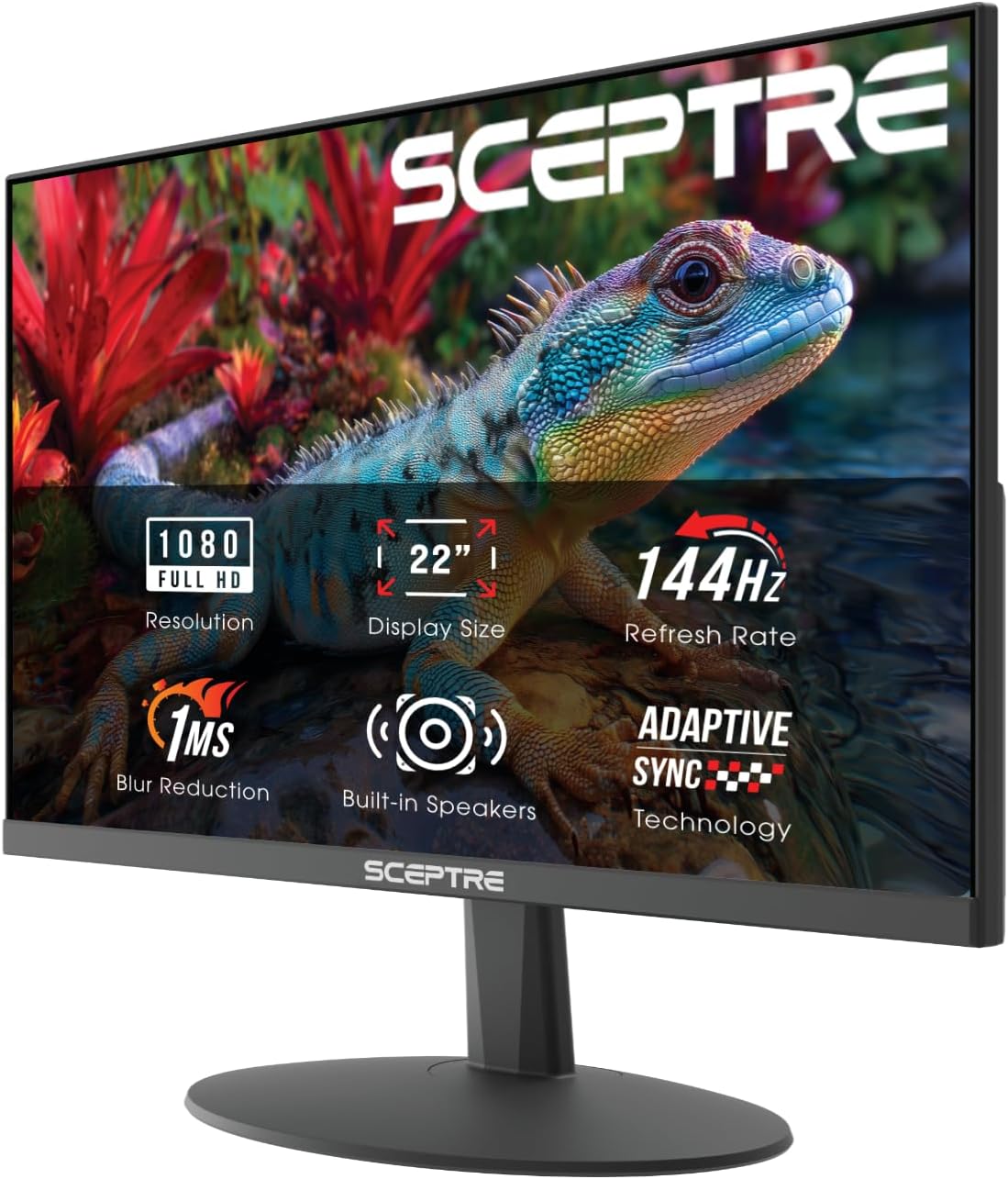
 SceptreSceptre New 22-Inch Gaming Monitor, FHD 1080p, Up to 144Hz, HDMI, DisplayPort,… SceptreSceptre New 22-Inch Gaming Monitor, FHD 1080p, Up to 144Hz, HDMI, DisplayPort,… |
4.4Very good | 1,353 | Sceptre New 22-Inch Gaming Monitor suits professionals and students who need a compact, straightforward 1080p display for smaller workstations. Featuring a 22-inch screen, up to 144Hz refresh rate, HDMI and DisplayPort connectivity, and built-in speakers, it provides reliable basic computing capability without requiring heavy-duty desk space or high-end graphics processing. View listing |
 AcerAcer 27in FHD 1920×1080 IPS 120Hz Gaming Monitor | Office KB272 G0bi AcerAcer 27in FHD 1920×1080 IPS 120Hz Gaming Monitor | Office KB272 G0bi |
4.6Very good | — | 1ms is designed for users who want a traditional 27-inch 1080p IPS panel with a 120Hz refresh rate. Offering 99 percent sRGB color gamut coverage, AdaptiveSync support, VESA mounting capability, and blue light filtering, this display delivers dependable daily office clarity for workflows that do not require dual-screen ultrawide dimensions. View listing |
 SansuiSANSUI 27 Inch Curved 240Hz Gaming Monitor FHD 1080P, 1500R Curve Computer… SansuiSANSUI 27 Inch Curved 240Hz Gaming Monitor FHD 1080P, 1500R Curve Computer… |
4.5Very good | — | SANSUI 27 Inch Curved 240Hz fits users who want high-speed 240Hz motion performance and an immersive 1500R curved form factor in a conventional desk size. With a 27-inch 1080p panel, 1ms MPRT response time, 4000:1 contrast ratio, and AMD FreeSync support, it provides curved immersion without the substantial footprint and GPU demands of a 57-inch chassis. View listing |
Ratings are the star averages left by Amazon buyers, not scores from our own testing. Prices are the ones on the listing when this page was written.
FAQ
What graphics card is needed to run this monitor at Dual UHD and 240Hz?
To run native 7680 by 2160 resolution at the full 240Hz refresh rate, your computer must feature a graphics card with DisplayPort 2.1 support. Graphics cards limited to DisplayPort 1.4 or older HDMI standards can drive the monitor, but they will be restricted to lower refresh rates such as 60Hz or 120Hz at native resolution due to data transmission limits.
Can the monitor display two separate computer inputs at the same time?
Yes, the monitor includes Picture-by-Picture functionality, which allows two different computers to be connected simultaneously via DisplayPort and HDMI. The display divides the screen into two side-by-side 16:9 native 4K workspaces, allowing you to view and control two systems without separate monitors.
How much desk depth does the 57-inch display require?
The monitor measures 19.7 inches deep from the back of the stand to the front base feet. Because the 1000R curve extends the edges forward into your field of view, a workstation desk with a depth of at least 30 to 36 inches is recommended to maintain a comfortable viewing distance and adequate keyboard space.
Does the matte display finish prevent workplace glare?
The panel uses a specialized matte screen finish designed to diffuse ambient light from overhead office fixtures and windows. This anti-glare treatment preserves contrast and text readability across the entire 52.3-inch width without distracting reflections interfering with your work.
Can the monitor be mounted on a standard monitor arm?
While the monitor is compatible with standard VESA mounting patterns, its 41.9-pound weight and wide curved profile require an industrial, heavy-duty monitor arm rated specifically for extreme ultrawide displays. Standard desk arms will sag or fail under the mass of this 57-inch chassis.
More Monitors ratings
See the section
Apple Thunderbolt 4 Pro Cable: The Definitive Cord for Apple Pro Display
Connecting a high-end reference screen to your workstation requires sufficient data throughput to prevent visual degradation, frame dropping, or reduced color precision. If you…

ASUS TUF VG249Q1A: A Decisive Look at Everyday Gaming Value
Finding a reliable desktop display that transitions seamlessly between spreadsheet work and competitive gaming can be challenging for busy professionals. The ASUS TUF VG249Q1A…

Samsung Odyssey OLED G9 Review: The Definitive Ultrawide Workspace Solution
Replacing a multi-display setup with a single continuous display requires balancing horizontal screen area against desk space and daily operational demands. The Samsung Odyssey…

ASUS ROG Swift PG32UCDM Review: A Decisive Display for Power Users
The ASUS ROG Swift PG32UCDM represents a major technical shift for demanding desktop users who refuse to compromise between ultra-dense visual precision and competitive…
Buyer favourite 4.5+ stars from 500 or more ratings

LG UltraGear 27GS93QE OLED Review: Speed, Contrast, and Final Verdict
When deciding whether to upgrade your desktop display, the LG UltraGear 27GS93QE immediately stands out as a focused performance option built around pure competitive…
Get new ratings by email
A weekly digest of the products added to the ratings pages.