Kodak Mobile Film Scanner Review: Novelty Toy or Real Digitizer?
For busy professionals sorting through decades of family archives, finding an efficient way to digitize vintage negatives without investing in complex laboratory equipment is a common priority. The Kodak Mobile Film Scanner…
By Brian Carver 9 min read

Kodak Mobile Film Scanner
Kodak
Fair
Our score: 7.4/10
Scores are out of 10, based on listed specifications and buyer feedback.
- Specs listed
- 12
- Section
- Cameras & Drones
Check price on Amazon We may earn a commission if you buy through this link.
As Amazon Associates, we earn from qualifying purchases. This means we may receive a small commission at no extra cost to you if you click through and make a purchase.
For busy professionals sorting through decades of family archives, finding an efficient way to digitize vintage negatives without investing in complex laboratory equipment is a common priority. The Kodak Mobile Film Scanner is designed as a minimalist, fold-out tabletop cradle that transforms an ordinary smartphone into a quick digitizing station. By combining a battery-powered LED illumination base with a collapsible cardboard riser, the device positions your handset directly above your film strip or mounted slide. Rather than functioning as a standalone motorized scanner, this unit serves as an entry-level smartphone film scanner engineered for casual viewing, experimental scanning, and rapid social media sharing directly from a mobile device.
Before purchasing, it is essential to understand the functional boundaries between a lightweight novelty viewer and an archival-grade digitizing workstation. The manufacturer explicitly notes that this cardboard unit is built primarily for play and casual experimentation rather than heavy-duty production workflows. In this comprehensive review, we examine the physical build quality, optical resolution realities, mobile application workflow, and media handling limitations to help you decide whether this quick mobile setup fits your immediate needs or if your archive demands dedicated hardware converters.


What You Get With the Kodak Mobile Film Scanner
The package contains a streamlined set of folding materials and lighting hardware designed for quick tabletop assembly without tools, cables, or secondary adapters.
In the box
- Collapsible heavy-duty cardboard scanning platform with an integrated overhead smartphone lens aperture.
- Interchangeable slide and film negative loading tray engineered for standard 35mm media formats.
- Internal battery-powered LED backlight module providing uniform bottom-up illumination.
- Access to the free Android companion mobile application for exposure adjustments, editing, and negative inversion.
- Self-contained fold-down chassis that collapses into a compact storage box for travel.
Key Specifications
| Brand and Model | KODAK Mobile Film Scanner |
|---|---|
| Scanner Type | Film Scanner (Smartphone-Based) |
| Product Dimensions | 5.8"D x 4.25"W x 4.2"H |
| Item Weight | 249 g |
| Listing Resolution | 1200 dpi |
| Color Depth | 24 bpp |
| Optical Sensor Technology | CCD (Listing Specification) |
| Light Source Type | Battery-Powered LED Backlight |
| Media Compatibility | 35mm Color Negatives, 35mm B&W Negatives, 35mm Color Slides |
| Standard Sheet Capacity | 1 Slide or Negative Frame |
| Connectivity Technology | USB |
| Minimum System Requirements | Windows 7 / Android OS |
All 20 attributes from the listing
| Scanner Type | Film |
|---|---|
| Connection Type | USB |
| Resolution | 1200 dpi |
| Color Depth | 24 bpp |
| Standard Sheet Capacity | 1 |
| Optical Sensor Technology | CCD |
| Light Source Type | LED |
| Media Type | Negatives, Photo, Slide |
| Item Dimensions D x W x H | 5.8"D x 4.25"W x 4.2"H |
| Item Weight | 249 g |
| Brand | KODAK |
| Model Name | Kodak Mobile Film Scanner |
| UPC | 843812105132 |
| Global Trade Identification Number | 00843812105132 |
| Manufacturer | KODAK |
| Best Sellers Rank | #52,835 in Office Products (See Top 100 in Office Products) #19 in Slide & Negative Scanners |
| ASIN | B07MTKNTPK |
| Minimum System Requirements | Windows 7 |
| Connectivity Technology | USB |
| Product Dimensions | 5.8"D x 4.25"W x 4.2"H |
Figures as published by the manufacturer on the Amazon listing.
Cardboard Construction and Structural Durability
The physical structure of this unit is made almost entirely from dense cardboard that folds out into a miniature tabletop light box. At just 249 grams, the chassis is remarkably light, folding down into a self-contained rectangular box that packs easily into a brief bag or storage drawer. This collapsible design makes it a convenient portable companion for an afternoon visit with family members, allowing you to examine vintage slides around a kitchen table without hauling heavy electronics or untangling power bricks.
However, relying on cardboard introduces obvious structural limitations for ongoing archival projects. Over extended use, folding cardboard tabs naturally soften, crease, and lose their rigid friction fit. Furthermore, modern flagship smartphones often weigh nearly as much as the entire scanner assembly. Placing a heavy smartphone on top of the upper platform can cause subtle sagging around the lens cutout, which tilts the phone camera relative to the illuminated film plane below.
Maintaining a strictly parallel plane between your phone camera sensor and the film emulsion is vital for edge-to-edge sharpness. If the cardboard cradle flexes or vibrates whenever you tap the screen to take a picture, focus shifts and corners turn soft. Photographers who shoot classic frames with a kodak ec35 35mm film camera understand that sharp analog reproduction requires steady, unyielding mechanical alignment, an operational standard that a paper-based folding stand struggles to maintain over dozens of consecutive captures.
Optical Resolution and Smartphone Camera Dependency
While the official kodak mobile film scanner specs list a resolution benchmark of 1200 dpi and a 24 bpp color depth, real-world image quality is dictated almost entirely by your smartphone camera hardware. Because the scanner itself contains no integrated digital camera sensor or internal imaging lens, the kodak mobile film scanner resolution is fundamentally limited by how well your phone handles close-up macro focusing through the cutout hole.
Standard smartphone cameras typically have a minimum focusing distance that exceeds the four-inch elevation provided by this cardboard stand. If your phone cannot lock focus at close range, the resulting frame will be blurry or distorted. To combat this, users must either rely on built-in digital zoom, which significantly reduces resolving detail, or manually position secondary macro clip-on lenses. The listing explicitly warns that image quality varies based on slide condition and camera optics, reminding users to repeatedly tap their mobile screen to force autofocus.
Illumination consistency is another major optical factor. The internal battery-powered LED provides gentle illumination, but it does not match the calibrated, high-CRI diffusion panels found in professional photographic labs. When digitizing classic color negative stocks such as kodak 200 gold, uneven light distribution or subtle color casts require extensive software adjustments to restore natural skin tones, meaning captures rarely look finished straight out of the box.
Scanning Workflow and Companion App Performance
Digitizing negatives requires specialized image inversion to turn orange-tinted negative film into natural positive photographs, which is handled here by the companion software. The listing highlights a free Android app designed to perform real-time color negative conversion, black-and-white inversion, basic crop adjustments, and direct sharing to social channels. The kodak mobile film scanner app handles the basic math of removing the orange film base, but users must manually adjust exposure sliders for each individual shot.
For professionals managing tight personal schedules, the manual workflow introduces considerable friction. Each step is entirely manual: you insert the film strip into the tray, align the frame visually beneath the top hole, adjust your phone on the cardboard platform, tap the phone screen to acquire focus, press the shutter button, and then apply inversion and cropping inside the app. Digitizing even two rolls of thirty-six exposures can easily stretch into an entire afternoon of repetitive screen tapping and manual alignment.
This smartphone-based workflow is adequate if your objective is simply to inspect mystery negatives or produce quick low-resolution digital copies to send to a compact snapshot printer like the kodak mini 3. However, for users who need consistent metadata tagging, automatic dust correction, batch frame advancement, or reliable color rendition across hundreds of heirloom memories, the app-based approach becomes an operational bottleneck.
Media Handling for 35mm Negatives and Mounted Slides
The unit features a dual-purpose film tray designed specifically to accept 35mm color film negatives, 35mm black-and-white film negatives, and standard 35mm mounted color slides. The kodak mobile film scanner 35mm mechanism relies on a single-sheet capacity format, meaning users must push film strips through the guide tracks frame by frame or feed mounted slides one at a time into the central aperture.
Handling vintage mounted slides presents unique mechanical hurdles. The kodak mobile film scanner for slides accommodates standard cardboard mounts smoothly, but older plastic or glass-mounted slides are considerably thicker and can jam against the tray slot. Because the tray lacks a motorized or spring-loaded continuous feed mechanism, each slide must be manually pushed in and pulled out, increasing the risk of fingerprints or smudges on delicate emulsion layers.
Curled negative strips present an even greater challenge. Film strips that have remained rolled tightly inside plastic canisters for decades naturally resist laying flat. Because the lightweight cardboard tray exerts minimal clamping pressure, curled film strips often bow upward in the center. This slight curve pushes the middle of the negative closer to the phone lens than the edges, creating a shallow depth-of-field mismatch where the center of your digitized image is in focus while the edges remain noticeably soft.
Kodak Mobile Film Scanner Pros and Cons
Pros
- Lightweight collapsible cardboard design for easy travel
- Battery-powered LED backlight for film illumination
- Supports 35mm color and monochrome film negatives
- Dedicated mobile application handles negative color inversion
- Folds flat into a compact self-contained box
Cons
- Cardboard construction lacks long-term structural durability
- Final image sharpness depends entirely on phone optics
- Manual frame-by-frame alignment causes noticeable workflow friction
Check Kodak Mobile Film Scanner on Amazon
Is the Kodak Mobile Film Scanner Worth It
Determining whether this cardboard scanner is worth your time depends entirely on your project scope and personal expectations. If you are searching for an entertaining, budget-conscious gift for children, grandparents, or hobbyists who want to inspect old family slides without technical frustration, this product fulfills its role. It delivers a tactile, nostalgic afternoon activity that lets you view forgotten snapshots and save basic reference images to your mobile camera roll without buying dedicated electronics.
Conversely, for busy professionals who need an organized, high-fidelity archival method to preserve decades of family history, this device is unlikely to satisfy. The time required to manually align each frame, combined with variable phone focus and the physical frailty of a folding cardboard chassis, creates substantial operational drag. If your goal is to generate crisp, high-resolution digital master files suitable for large wall prints or permanent archival preservation, investing your time into manual smartphone alignment will yield diminishing returns.
Ultimately, the manufacturer accurately positions this device as a fun, accessible tool mostly for play and experimentation rather than a production-grade digitizer. If your collection contains only a handful of loose slides that you want to post online quickly, it offers an easy entry point. If you have several boxes of film, stepping up to dedicated desktop converters will save countless hours and deliver significantly sharper results.
Other Options to Consider
| Model | Our score | Why it is here |
|---|---|---|
 KodakKODAK Mobile Film Scanner, 35mm Negative Scanner & Slide Viewer, App-BasedReviewed here |
7.4/10Fair | The model reviewed on this page. View listing |
 KodakKODAK Slide N Scan Film & Slide Scanner, 22MP, 5" LCD Screen,… |
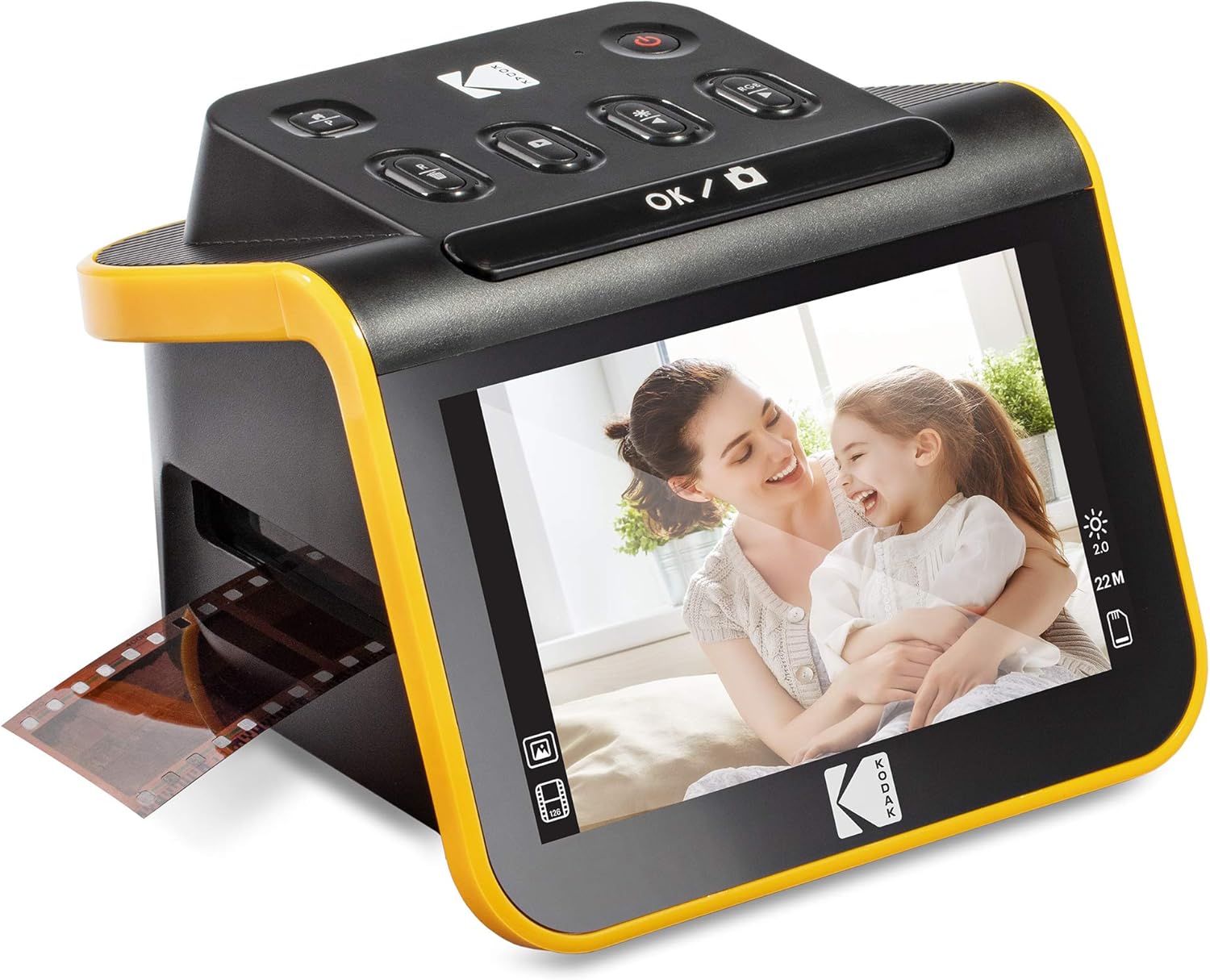
8.6/10Good | Converts color and B&W negatives: Built as a true standalone workstation, the KODAK Slide N Scan Film & Slide Scanner features a dedicated 22MP sensor, a 5-inch integrated LCD preview display, direct saving to an SD or SDHC card, and broad compatibility across 135, 110, and 126mm film formats without requiring a smartphone. It is far better suited for professionals who want consistent optical focus, rapid continuous slide feeding, and direct video output to a TV or computer monitor, as detailed in our kodak slide and scan evaluation. View listing |
 MagnasonicMagnasonic All-in-One 24MP Film Scanner with Large 5" Display & HDMI, Converts… |
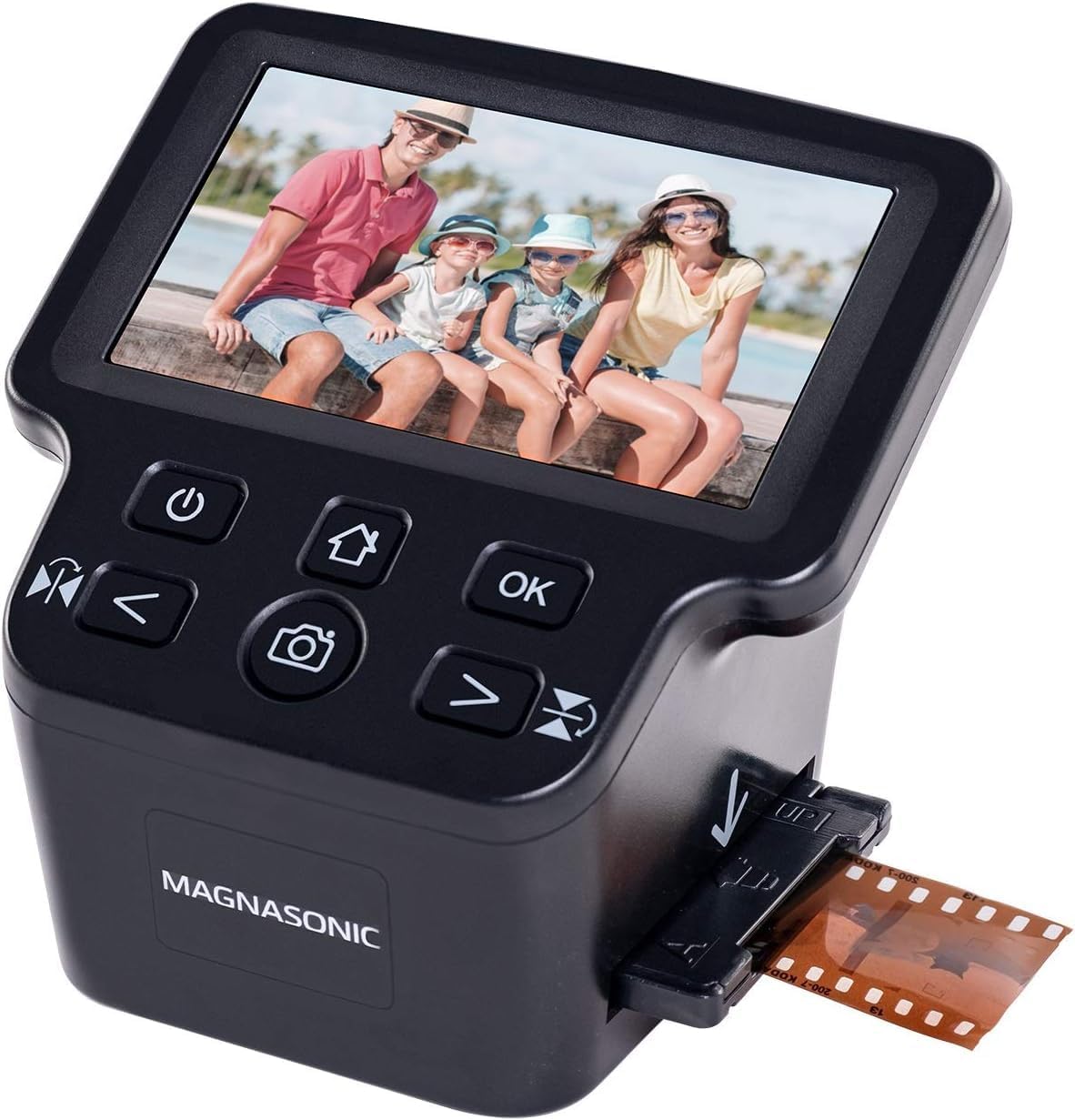
8.6/10Good | Magnasonic All-in-One 24MP Film Scanner: This dedicated hardware unit incorporates a 24MP optical scanning sensor, a 5-inch display screen, HDMI output capabilities, 128MB of built-in internal memory, and extensive media adapters covering 35mm, 126, 110, and Super 8 film alongside standard mounted slides. It represents a superior option for collectors who manage mixed-format physical archives that extend beyond standard 35mm film strips. View listing |
 KodakKODAK Slide N Scan Max Film Scanner, Slide Scanner, Black/Yellow |
8.4/10Good | Slide to Digital Converter: Branded as the KODAK Slide N Scan Max, this high-throughput desktop converter features an expanded 7-inch tilting LCD display, continuous feed slide brackets, one-touch internal editing controls, and direct SD card capture for 135mm, 110mm, and 126mm media types. It is specifically tailored for users working through large family collections who require effortless visual inspection on a large screen without relying on mobile app workarounds. View listing |
Scores are out of 10, based on listed specifications and buyer feedback. Prices are the ones on the listing when this page was written.
FAQ
Does the Kodak Mobile Film Scanner require a computer to operate?
No, the unit operates entirely without a desktop computer during capture, relying instead on your smartphone and its mobile application to photograph, invert, and save your memories. Although the product specifications note Windows 7 as a baseline system requirement, everyday photo capture is completed directly on your mobile device.
What formats can this cardboard film scanner digitize?
The scanner is designed strictly for standard 35mm color film negatives, 35mm black-and-white film negatives, and standard 35mm mounted color slides. The listing does not specify support for medium format 120 film, 110 cartridges, 126 formats, or movie film.
How does the companion application convert film negatives into regular photos?
The mobile application uses internal color inversion algorithms that reverse negative values and filter out the amber mask typical of color negative film. The software also provides cropping tools and basic exposure adjustments so you can clean up the image before saving it to your smartphone storage.
What power source does the LED backlight require?
The internal illumination base is powered by standard batteries to provide subtle, uniform backlighting beneath the film tray without requiring a constant wall connection. While the listing specifications mention USB connectivity technology, standard portable operation uses internal battery power.
Can heavier smartphones cause the cardboard stand to collapse?
The heavy-duty cardboard platform is designed to support common mobile devices, but larger flagship smartphones with thick protective cases can cause slight top-plate flex over time. Placing your phone down gently over the aperture hole and tapping the screen lightly helps maintain steady optical alignment and prevents structural bowing.
More Cameras & Drones ratings
See the section
Fujifilm Instax Mini 12 Review: Quick Verdict on the Instant Camera Bundle
If you are deciding whether to purchase the Fujifilm Instax Mini 12, the short answer is that it represents one of the simplest, most…

XbotGo Falcon AI Sports Camera: Decisive Review for Busy Coaches
Busy coaches and sports parents often struggle to balance active sideline leadership with the tedious chore of operating a video camera. The XbotGo Falcon…

Canon RF-S 55-210mm Lens Review: Compact Reach for EOS R Shooters
Photographers investing in the Canon EOS R mirrorless ecosystem often hit an early crossroad when looking beyond basic kit glass. The Canon RF-S 55-210mm…

Sony a7 III Mirrorless Camera: The Decisive Assessment for Working Pros
Deciding on a reliable workhorse camera requires balancing image fidelity, autofocus reliability, and operational speed. The Sony a7 III represents one of the most…
Buyer favourite Scored 9.0+/10

Canon EF 24-70mm f/4L IS USM Zoom: Fast Decision Guide
Selecting a standard 24-70 mm canon lens requires balancing optical quality, physical bulk, and shooting versatility. The Canon EF 24-70mm f/4L IS USM provides…
Get new ratings by email
A weekly digest of the products added to the ratings pages.