Dorhea ESP32-S3 Mini: Fast Buying Verdict for IoT Projects
Engineers seeking a compact microcontroller for dense wireless setups will find that the Dorhea ESP32-S3 Mini provides a balanced hardware package built for space-constrained enclosures. If you need modern wireless capability alongside…
By Samuel Rhodes 9 min read

Dorhea ESP32-S3 Mini
Dorhea
Very good
Our score: 9.2/10
Scores are out of 10, based on listed specifications and buyer feedback.
- Specs listed
- 10
- Section
- Gaming
Check price on Amazon We may earn a commission if you buy through this link.
As Amazon Associates, we earn from qualifying purchases. This means we may receive a small commission at no extra cost to you if you click through and make a purchase.
Engineers seeking a compact microcontroller for dense wireless setups will find that the Dorhea ESP32-S3 Mini provides a balanced hardware package built for space-constrained enclosures. If you need modern wireless capability alongside dedicated hardware encryption, this compact board delivers the core benefits of the Espressif architecture without the physical footprint of standard evaluation units. This two-pack package serves developers assembling compact sensors, wearable prototypes, or discrete connected nodes that do not require dozens of breakout headers. In this dorhea esp32 s3 mini review, we examine the practical trade-offs to determine whether it matches your deployment requirements.
Selecting an esp32 mini s3 development platform means weighing physical component density against available input-output lines and peripheral expansion. While larger development kits expose dozens of general-purpose pins, this miniature board focuses strictly on core essentials by integrating critical radio hardware and memory into a single-sided surface-mount layout. This detailed evaluation examines the official esp32 mini s3 specs, investigates wireless reception and cryptographic features, breaks down the board pinout, and answers whether this hardware package provides the reliability needed for practical connected projects.
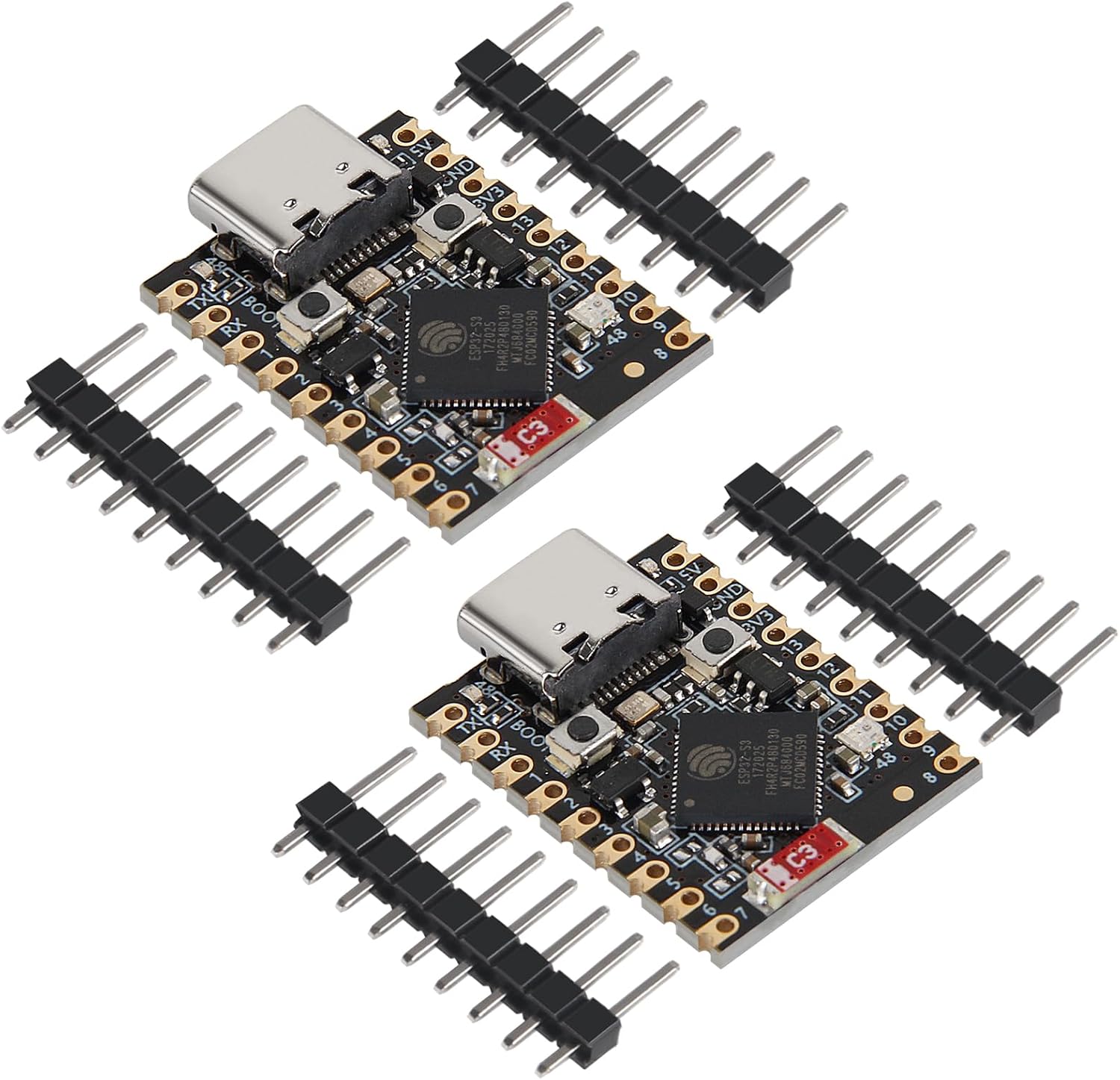

What You Get With the Dorhea ESP32-S3 Mini
The Dorhea ESP32-S3 Mini is packaged as a two-piece development kit intended for rapid testing and compact deployment across connected embedded systems. Based on the manufacturer data, the kit provides the core hardware components needed to run networked tasks in confined project housings.
In the box
- Two Dorhea ESP32-S3 Mini development boards (part number DAD12551-1)
- Espressif 32-bit single-core ESP32-S3 processor running at 160 MHz with floating-point acceleration
- Built-in 4MB SPI flash memory storage and 400KB SRAM
- Integrated 384KB ROM for system startup routines
- 2.4 GHz 802.11b/g/n Wi-Fi and Bluetooth 5 LE wireless subsystem
- External antenna assembly designed to enhance wireless signal range
- Hardware security engine supporting AES-128, AES-256, and RSA encryption
- Single-sided surface-mount PCB layout exposing 11 digital and 4 analog connections
Key Specifications
| Processor | Espressif ESP32-S3 32-bit at 160 MHz |
|---|---|
| Processor Count | Single-core (1 processor listed in technical details) |
| Flash Memory | 4 MB onboard storage |
| SRAM | 400 KB |
| ROM | 384 KB |
| Wireless Connectivity | 802.11b/g/n Wi-Fi (2.4 GHz) and Bluetooth 5 (LE) |
| Hardware Security | Cryptographic accelerator (AES-128/256, RSA, Secure Boot) |
| GPIO and ADC Channels | 11 digital I/O pins (PWM capable) and 4 analog ADC inputs |
| Operating Systems | ESP-IDF, FreeRTOS, Linux host development |
| Package Quantity | 2 boards per pack |
All 20 attributes from the listing
| Memory Storage Capacity | 4 MB |
|---|---|
| Processor Speed | 160 MHz |
| Connectivity Technology | Bluetooth, Wi-Fi |
| Processor Brand | Espressif |
| Compatible Devices | Microcontrollers, Sensors, Actuators |
| RAM Memory Technology | SRAM |
| Processor Count | 1 |
| Brand | DORHEA |
| Built-In Media | ESP32-S3 |
| Number of Packs | 2 |
| Number of Items | 1 |
| UPC | 687117792709 |
| Unit Count | 2 Count |
| Manufacturer | DORHEA |
| Mfr Part Number | DAD12551-1 |
| Warranty Description | no |
| Best Sellers Rank | #764 in Single Board Computers (Computers & Accessories) |
| ASIN | B0GFDDG8FK |
| CPU Speed | 160 MHz |
| Included Components | ESP32-S3 |
Figures as published by the manufacturer on the Amazon listing.
Processing Power and Cryptographic Security
The computational engine of this esp32-s3 mini dev board relies on a 160 MHz 32-bit architecture featuring an integrated Floating Point Unit. The FPU accelerates single-precision arithmetic routines, allowing real-time processing of digital signals, sensor filtering, and mathematical operations that would overwhelm lower-tier 8-bit or standard 32-bit microcontrollers. While the product listing title mentions a dual-core processor, the manufacturer technical specifications explicitly state a single-core configuration with a processor count of one running at 160 MHz. Developers designing multi-threaded tasks should account for this specification detail to balance execution loops within single-core FreeRTOS environments.
Embedded security serves as an essential requirement for field hardware deployed across unsecured commercial and residential networks. The hardware cryptographic accelerator built directly into the silicon provides dedicated execution for AES-128, AES-256, and RSA encryption standards. By offloading cryptographic handshakes into silicon rather than executing them through software routines, the system maintains secure TLS connections without stalling time-sensitive sensor acquisition loops. The inclusion of secure boot capabilities prevents unauthorized firmware tampering, ensuring your device boots only verified application binaries.
Memory capacity directly governs runtime stability when managing communication buffers and complex network stacks. Equipped with 400KB SRAM and 384KB ROM, the board leaves sufficient operational memory for networking buffers, MQTT communication queues, and local state management. Furthermore, the esp32-s3 mini 4mb flash capacity accommodates substantial application code, bootloader structures, partition tables, and dual-OTA update partitions for remote field maintenance. For compact edge installations interfacing with centralized local micro-servers like the gmktec evo x2, local silicon encryption safeguards telemetry before transmission across local network infrastructure.
Wireless Range and External Antenna Support
Reliable radio performance determines whether an edge device remains responsive or drops offline inside challenging environments. The esp32-s3 mini wifi bluetooth subsystem supports 2.4 GHz IEEE 802.11b/g/n networking alongside Bluetooth 5 Low Energy. It allows flexible network configurations, operating in standard Station mode to link into existing Wi-Fi networks or in SoftAP mode to act as an independent configuration beacon. Bluetooth 5 LE support introduces streamlined point-to-point provisioning, enabling technicians to configure network credentials directly from a mobile device without exposing temporary web credentials over open networks.
The physical antenna setup provides a substantial advantage over alternatives that rely solely on compact onboard PCB trace antennas. The Dorhea board comes equipped with an external antenna assembly, noticeably improving signal sensitivity and broadcast reception. Tiny internal antennas frequently suffer attenuation when placed inside dense plastic enclosures, metal-framed equipment, or behind structural obstacles. By routing radio energy through an external antenna, the board maintains reliable packet delivery across distances where standard compact boards struggle with transmission drops and packet retries.
Power management across wireless modes is critical when engineering battery-backed nodes or remote data loggers. The ESP32-S3 radio stack provides configurable sleep modes that shut down transceiver power between transmission windows. When paired with FreeRTOS task scheduling, developers can orchestrate predictable duty cycles where the system wakes up, samples attached sensors, encrypts the payload, transmits data over Wi-Fi, and transitions back to low-power idle states in milliseconds. This operational pattern ensures the improved signal range from the external antenna does not exhaust system power reserves.
Pinout Constraints and Peripheral Connectivity
Miniature hardware always involves physical trade-offs, and the physical esp32 s3 mini pinout highlights this engineering reality. The listing identifies 11 digital I/O pins capable of pulse-width modulation alongside 4 dedicated analog input channels linked to the internal analog-to-digital converter. For small form-factor devices, these 11 configurable pins provide sufficient lines to interface with standard SPI or I2C sensor boards, trigger status indicators, and control output switches. However, complex multi-device setups requiring dozens of dedicated GPIOs will quickly exhaust available connections, requiring external shift registers or I2C expanders.
The single-sided surface-mount layout keeps the board profile exceptionally slim, easing integration into custom 3D-printed enclosures, wearable projects, or compact breakout assemblies. The board exposes essential peripheral interfaces, including UART for serial communication, SPI for high-speed sensor or display communication, and I2C for digital environmental sensors. If your application requires an even simpler single-core architecture, comparing this layout with an esp32 c3 mini offers useful perspective on pin breakout trade-offs across compact microcontroller families.
For analog instrumentation, the 4 dedicated ADC channels offer the essential sampling points needed for thermistors, light sensors, or analog current monitors. Because all 11 digital pins support software-configurable PWM channels, the board handles multi-channel LED dimming, motor speed modulation, and audio buzzer synthesis directly. The main challenge remains careful planning during the schematic phase, as shared pin functions mean configuring SPI or I2C may reduce the number of independent digital triggers available for discrete switching.
Development Frameworks and Firmware Workflow
Implementing this hardware into a practical development cycle depends on toolchain compatibility and driver support. The manufacturer lists compatibility across Linux host systems, FreeRTOS, and Espressif’s native ESP-IDF framework. For engineers requiring deep control over register access, memory optimization, and security keys, ESP-IDF provides the most comprehensive toolchain, complete with granular configuration menus for clock frequencies, flash partitioning, and cryptographic acceleration. Firmware development under FreeRTOS enables deterministic preemptive multitasking, isolating background networking routines from critical timing loops.
For rapid prototyping, developers can utilize community board configurations within development environments that support ESP32-S3 microcontrollers. Although Dorhea provides minimal standalone custom software, the core Espressif ESP32-S3 architecture is universally supported across major open-source firmware platforms, including Arduino core implementations and MicroPython. Flashing and debugging occur over standard serial UART connections, making it straightforward to connect serial adapters for initial bootloader interaction and serial log monitoring.
Maintainability over long deployment cycles is supported by the partition architecture enabled by the 4MB flash chip. With standard dual-OTA partition layouts, developers can write and deploy network-based firmware updates securely without physically recovering installed boards. The hardware-based cryptographic engine verifies downloaded firmware image signatures before writing them to active execution blocks, ensuring failed flashes or intercepted binaries do not brick devices deployed in inaccessible locations.
Dorhea ESP32-S3 Mini Pros and Cons
Pros
- Compact form factor for space-constrained builds
- External antenna for improved wireless reception
- Dedicated hardware cryptographic accelerator
- Integrated 4MB flash and 400KB SRAM
- Dual wireless support with WiFi and Bluetooth 5
Cons
- Limited to 11 digital and 4 analog pins
- Listing lacks manufacturer warranty coverage
- Listing title conflicts with single-core processor specification
Check Dorhea ESP32-S3 Mini on Amazon
Is the Dorhea ESP32-S3 Mini Worth It
Deciding whether this hardware suits your deployment comes down to project physical size versus interface requirements. If you are building space-constrained connected devices that require robust encryption, Wi-Fi telemetry, and external antenna reception, the Dorhea board provides exceptional utility. It condenses modern wireless and computational capabilities into a remarkably small form factor, making it ideal for engineers building custom smart-home switches, discrete remote sensors, and wearable IoT monitors where standard developer boards are simply too bulky.
On the other hand, engineers looking for a sprawling development platform to prototype complex multi-component systems may find the 11 digital GPIO limit restrictive. If your project demands dozens of physical pins, extensive parallel interfaces, or plug-and-play shield compatibility, standard full-sized development boards will save significant development time. Furthermore, the product comes without an explicit manufacturer warranty, making it primarily suited for experienced developers and makers comfortable troubleshooting board-level hardware independently.
For professionals evaluating is esp32 mini s3 worth it for connected deployments, the two-pack offering delivers great practical value. Having two identical boards allows developers to dedicate one unit to benchtop firmware debugging while the other undergoes thermal or enclosure validation in the field. When your design criteria prioritize a compact single-sided footprint, wireless range, and cryptographic security over raw pin counts, this esp32 mini s3 for iot delivers a dependable hardware foundation.
Other Options to Consider
| Model | Our score | Why it is here |
|---|---|---|
 Dorhea2Pcs ESP32 S3 Mini Development Board ESP32-S3 with WiFi Bluetooth Dual-Core Processor…Reviewed here |
9.2/10Very good | The model reviewed on this page. View listing |
 ArduinoArduino Uno REV3 [A000066] – ATmega328P Microcontroller, 16MHz, 14 Digital I/O Pins,… |
9.6/10Excellent | Arduino Uno REV3 suits developers who prioritize standard 5V logic, a massive community shield ecosystem, and broad educational documentation over wireless connectivity and miniaturization. Running an ATmega328P microcontroller at 16 MHz with 32KB flash memory, 14 digital I/O pins, and 6 analog inputs, it offers physical breadboard-friendly prototyping without the specialized surface-mount layout or 3.3V logic considerations of the ESP32-S3. View listing |
Scores are out of 10, based on listed specifications and buyer feedback. Prices are the ones on the listing when this page was written.
FAQ
Does the board support both Wi-Fi and Bluetooth simultaneously?
Yes, the ESP32-S3 architecture features a dual-mode radio supporting 2.4 GHz 802.11b/g/n Wi-Fi and Bluetooth 5 Low Energy. This allows developers to use Bluetooth for local mobile commissioning while maintaining Wi-Fi communication for cloud data transmission.
What is the maximum CPU clock speed of the processor?
According to the manufacturer listing specifications, the 32-bit processor operates at a clock speed of 160 MHz with an integrated Floating Point Unit for single-precision math tasks.
How many GPIO pins are available for external sensors?
The board exposes 11 digital I/O pins that support pulse-width modulation output and 4 dedicated analog input channels connected to the internal ADC for sensor readings.
Does the Dorhea ESP32-S3 Mini come with a manufacturer warranty?
The listing specifications state no warranty coverage is provided by the manufacturer, so developers should test their units upon delivery.
What operating systems and frameworks can run on this board?
The hardware supports Espressif’s official ESP-IDF development framework and FreeRTOS, and host development is fully compatible with Linux environments.
More Gaming ratings
See the section
MOZA KS Wheel Review: Built for Serious GT Sim Racing
Choosing the right rim for competitive GT and prototype racing demands a balance between tactile feedback, switchgear access, and chassis rigidity. The MOZA KS…

HORI Mario Kart Racing Wheel: A Quick Buyer’s Guide
Deciding on the right controller accessory for kart racing comes down to whether you prioritize instant convenience or heavy simulation hardware. The HORI Mario…

ASUS ROG Azoth Extreme: Decisive Evaluation for Serious Competitors
Shoppers tracking high-end gaming hardware under the asus rog falcata search query will find their target in the ASUS ROG Azoth Extreme, an uncompromising…

Logitech G29 Driving Force: Fast Verdict for Busy Gamers
For busy professionals seeking a dependable entry point into virtual motorsport, the Logitech G29 offers an immediate, hardware-complete solution that balances physical realism with…
Buyer favourite Scored 9.0+/10

MindWare Flex Flash: A Fast Buying Guide for Busy Parents
When shopping for mind flex games that get children off the couch, parents frequently find themselves choosing between passive screen entertainment and physical toys…
Get new ratings by email
A weekly digest of the products added to the ratings pages.