DJI Goggles 3 Review: Reliable O4 FPV for Fast Workflows
When evaluating the DJI Goggles 3 for professional aerial workflows, the central question is whether the jump to the O4 transmission ecosystem delivers enough stability, range, and multi-aircraft utility to justify updating…
By Brian Carver 10 min read

DJI Goggles 3
DJI
Very good
4.5 out of 5
Average of 623 Amazon buyer ratings — not a score from testing of our own
- Ratings counted
- 623
- Specs listed
- 10
- Section
- Cameras & Drones
Buyer favourite Rated 4.5 or better by at least 500 people
Check price on Amazon We may earn a commission if you buy through this link.
How buyers rated it
Share of 623 Amazon ratings.
As Amazon Associates, we earn from qualifying purchases. This means we may receive a small commission at no extra cost to you if you click through and make a purchase.
When evaluating the DJI Goggles 3 for professional aerial workflows, the central question is whether the jump to the O4 transmission ecosystem delivers enough stability, range, and multi-aircraft utility to justify updating your fleet gear. For drone operators piloting platforms like the Avata 2, Air 3, or Mini 4 Pro, these FPV goggles replace tethered battery packs with an integrated headband power source, upgrade the visual feed to 1080p Micro-OLED panels running at up to 100 Hz, and lower transmission latency down to 24 ms. If your day-to-day operations demand reliable digital video links, seamless integration across camera drones and FPV quadcopters, and the ability to maintain peripheral environmental awareness without lifting your headset, this hardware package represents a targeted operational upgrade.
Deciding to integrate this headset depends on your current controller lineup and the specific airframes you deploy in the field. While the hardware excels when paired with modern O4-based drones and contemporary remote options like the DJI RC Motion 3 or DJI RC 2, it drops backward compatibility with older transmitters such as the DJI RC Motion 2 and the first-generation DJI FPV Remote Controller. This dji goggles 3 review breaks down the essential performance points, covering real-world O4 signal behavior, optical fidelity, battery endurance, fleet interoperability, and whether upgrading streamlines your flight day. For operators comparing different headset categories or exploring alternatives such as the dji goggles n3, understanding these technical trade-offs is crucial before restructuring your field kit.


What You Get With the DJI Goggles 3
The DJI Goggles 3 package delivers a self-contained digital viewing system engineered to eliminate external wiring while housing the battery, antennas, and display components directly within the chassis structure.
In the box
- Integrated headband and lithium-ion battery system delivering up to a 3-hour operating time without dangling external cables.
- Dual 1080p Micro-OLED display panels featuring a maximum refresh rate of 100 Hz and TÜV Rheinland Low Blue Light Certification.
- Built-in adjustable diopter knobs supporting vision correction from -6.0 D to +2.0 D for quick adjustments in the field.
- Front-facing dual CMOS optical sensors enabling the Real View PiP situational monitoring mode.
- One-tap defogging system designed to rapidly clear internal optical condensation during environmental shifts.
- DJI O4 digital video transmission technology capable of 60Mbps bitrate and latency as low as 24 ms.
- Wi-Fi wireless video streaming to mirror the pilot’s live feed directly to smartphones running the DJI Fly app.
- MicroSD card slot supporting local 4K video playback for panoramic and 3D media files.
Key Specifications
| Model Name | TKGS3 |
|---|---|
| Product Weight | 0.47 kg |
| Display Resolution | 1080p Micro-OLED |
| Display Refresh Rate | Up to 100 Hz |
| Video Transmission System | DJI O4 HD Transmission (24 ms latency, 60Mbps bitrate) |
| Optical Adjustment Range | Diopter adjustment from -6.0 D to +2.0 D |
| Battery Life | Up to 3 hours operating time |
| Situational Awareness Feature | Real View PiP via integrated CMOS cameras |
| Supported Playback Formats | 4K, MP4, MOV (including 3D and panoramic) |
| Defogging Feature | One-tap defogging functionality |
All 33 attributes from the listing
| Special Features | O4 Wireless Transmission; One-Tap Defogging, View Surroundings with Real View PiP; Adjust Sharpness and Noise Reduction |
|---|---|
| Video Capture Resolution | 4K |
| Connectivity Technology | Wi-Fi |
| Skill Level | Intermediate |
| Video Capture Format | MP4, MOV |
| Remote Control Technology | Radio Frequency (RF) |
| Control Type | Remote Control |
| Wireless Communication Technology | Wi-Fi |
| Battery Cell Composition | Lithium Ion |
| Video Output Resolution | 1080p |
| Optical Sensor Technology | CMOS |
| Color | black |
| Material | Plastic |
| Item Weight | 0.47 kg |
| Brand Name | DJI |
| Model Name | TKGS3 |
| Age Range Description | Adult |
| Included Components | DJI Goggles 3 -2.0D Corrective Lenses (Pair) × 1, DJI Goggles 3 Additional Forehead Pad × 1, DJI Goggles 3 Foam Padding × 1, DJI Goggles 3 × 1, USB Type-C Cable See more |
| Number of Items | 1 |
| Unit Count | 1 Count |
| Number of Packs | 1 |
| UPC | 190021105164 |
| Global Trade Identification Number | 06941565980069 |
| Manufacturer | DJI |
| Model Number | 6941565980069 |
| Part Number | 6941565980069 |
| Warranty Description | DJI |
| Best Sellers Rank | #31,387 in Toys & Games (See Top 100 in Toys & Games) #195 in Hobby Remote & App Controlled Vehicle Parts |
| ASIN | B0CS6L6D6J |
| Customer Reviews | 4.5 4.5 out of 5 stars (623) 4.5 out of 5 stars |
| Brand | DJI |
| Special Feature | O4 Wireless Transmission; One-Tap Defogging, View Surroundings with Real View PiP; Adjust Sharpness and Noise Reduction See more |
| Age Range (Description) | Adult |
Figures as published by the manufacturer on the Amazon listing.
O4 Video Transmission and Latency in the Field
Video transmission stability forms the backbone of any commercial aerial task, where a dropped frame or signal compression artifact can interrupt a critical framing run or inspection flight. As dedicated dji o4 video transmission goggles, the unit utilizes DJI’s latest RF transmission protocol, achieving video bitrates up to 60Mbps and low-latency performance clocked at 24 ms when paired with compatible aircraft. In high-interference environments or complex outdoor locations where signal reflection is a factor, this high-bandwidth link delivers crisp, continuous 1080p video feeds at up to 100 frames per second without the micro-stutter common in older digital transmission generations.
When operating the dji goggles 3 avata 2 combination, the responsiveness of the 24 ms link changes how aggressively a pilot can navigate confined gaps or conduct rapid low-altitude passes. Operators tracking fast-moving subjects benefit from the instantaneous feedback loop between stick input and visual confirmation on the Micro-OLED screen. For crews planning expansions with future airframes or examining related dynamic camera drones like the dji drone avata 3, the stability of the O4 signal architecture serves as an operational baseline that minimizes link loss anxiety during complex production shoots.
Beyond raw latency figures, the system dynamically manages transmission frequencies over Wi-Fi and Radio Frequency bands, automatically matching firmware profiles based on the connected aircraft under FCC guidelines. This automatic link optimization guarantees that whether you are conducting precision commercial surveys or fast FPV video capture, the video feed maintains priority data throughput. For busy professionals who cannot afford downtime diagnosing signal dropouts, the O4 protocol represents an exceptionally reliable digital transmission standard.
Fleet Compatibility and Remote Controller Pairing
A primary consideration for commercial drone departments is hardware interoperability across multiple aircraft classes. Understanding dji goggles 3 compatibility prevents unexpected field downtime, as the headset is designed to bridge traditional camera platforms and dedicated first-person view craft. The unit pairs directly with the DJI Neo, DJI Avata 2, DJI Mini 4 Pro, and DJI Air 3, alongside custom digital builds using the DJI O3 Air Unit, DJI O4 Air Unit, or DJI O4 Air Unit Pro. This broad device support enables a solo operator to transition from flying an ultra-light quadcopter to a full-frame aerial rig using a single visual interface.
Utilizing the dji goggles 3 for mini 4 pro operations transforms a standard sub-249-gram photography platform into an immersive framing tool. When flying compact camera drones, pilots can use standard remote systems like the DJI RC-N2 or DJI RC 2, as well as the specialized DJI RC Motion 3 or DJI FPV Remote Controller 3. Being able to inspect tight architectural features or inspect building envelopes with an immersive perspective while keeping payload weight minimal creates significant efficiency gains on job sites.
However, fleet managers must audit their current inventory before deploying this headset. The DJI Goggles 3 explicitly does not support older controllers, notably dropping compatibility with the DJI RC Motion 2 and the original DJI FPV Remote Controller. Operators who rely on legacy control hardware will need to factor in controller updates. For teams running hybrid production gear—such as balancing aerial flights with ground camera support via tools like the dji rs 3 mini gimbal stabilizer—standardizing on modern control peripherals ensures smooth handoffs between ground crews and flight technicians.
Micro-OLED Display Clarity and Ergonomic Design
Visual fatigue is an unavoidable hazard during multi-hour commercial flight days, making panel specifications and physical weight distribution critical buying factors. The dji goggles 3 specs center around two 1080p Micro-OLED panels that provide exceptional contrast, rich black levels, and vibrant color representation. Backed by TÜV Rheinland Low Blue Light Certification, these displays reduce eye strain during prolonged inspection sessions or extended commercial filming schedules where operators must stay under the hood for multiple battery cycles.
The optical stack features integrated diopter adjustment knobs capable of dialing vision correction between -6.0 D and +2.0 D. This built-in range accommodates both nearsighted and farsighted pilots directly, eliminating the hassle of carrying separate corrective lens inserts or cramming eyeglasses inside the facial foam. Furthermore, the inclusion of a one-tap defogging system resolves a classic headache in early morning or humid operations: with a single command, internal ventilation clears optical fogging caused by body heat and temperature differentials.
From an ergonomic perspective, the dji goggles 3 battery life is directly integrated into the headband structure, distributing the 0.47 kg total weight evenly across the crown of the head. By embedding the lithium-ion battery into the rear head strap, the headset completely removes the need for dangling power cords, pocket battery packs, or snag hazards on site. Delivering up to 3 hours of continuous operational runtime on a full charge, the built-in cell easily covers several standard multi-battery drone missions without requiring constant field charging.
Real View PiP and Operational Site Safety
Commercial job sites present unique safety challenges where taking your eyes off the physical environment poses operational risks. The dji goggles 3 real view pip feature directly targets this hazard by utilizing front-mounted CMOS optical sensors to provide a Picture-in-Picture window of the operator’s real-world surroundings. By tapping the side of the headset or activating the function, pilots can monitor takeoff zones, check battery levels on ground equipment, or track approaching personnel without removing the goggles.
This pass-through visual capability significantly streamlines solo operator workflows. In standard FPV setups, landing an aircraft, checking air traffic, or swapping batteries requires constantly sliding goggles up onto the forehead, leading to dropped gear, smudged lenses, or lost visual connection. Real View PiP allows pilots to keep the hardware seated comfortably on the face while maintaining essential spatial awareness, satisfying strict safety requirements on active industrial sites or crowded public production sets.
Additionally, the headset supports real-time wireless streaming via integrated Wi-Fi connectivity. By broadcasting the flight feed directly to a smartphone or tablet running the DJI Fly app, spotters, visual observers, or clients can monitor flight operations without crowding the pilot. The internal media engine also supports local playback of 4K MP4 and MOV files, allowing crews to review footage, 3D media, or panoramic imagery directly on the Micro-OLED displays immediately following a flight run.
DJI Goggles 3 Pros and Cons
Pros
- Low 24 ms latency with O4 digital transmission
- Integrated headband battery eliminates hanging cables
- Vibrant 1080p Micro-OLED displays with 100 Hz refresh
- Built-in diopter adjustment from -6.0 D to +2.0 D
- Real View PiP maintains situational ground awareness
- One-tap defogging clears optical condensation fast
Cons
- Incompatible with DJI RC Motion 2 remote controller
- Does not support original DJI FPV Remote Controller
- Restricted to compatible DJI digital video ecosystems
Is the DJI Goggles 3 Worth It
Determining if the dji goggle 3 represents a sound commercial investment comes down to your existing hardware ecosystem and operational demands. For aerial cinematography teams and professional drone operators deploying O4-enabled platforms like the Avata 2, Air 3, or Mini 4 Pro, the upgrade delivers substantial value. The combination of integrated headband power, 1080p 100 Hz Micro-OLED screens, 24 ms low latency, and built-in diopter correction eliminates the primary workflow bottlenecks associated with older tethered FPV gear.
For operations prioritizing safety compliance and efficient single-pilot execution, the Real View PiP situational monitoring system alone justifies the hardware switch. Being able to inspect ground surroundings without pulling off the headset keeps flights compliant and reduces job site friction. Furthermore, client-facing Wi-Fi streaming directly into the DJI Fly app simplifies on-set monitoring for creative directors who need immediate confirmation of shot framing.
Conversely, if your fleet is anchored entirely around older O3 transmission drones or relies strictly on legacy controllers like the DJI RC Motion 2 or the original DJI FPV Remote Controller, upgrading demands a broader overhaul of your peripheral equipment. If you do not operate O4-compatible aircraft, you will not access the core transmission and latency improvements of this unit. For pilots committed to modern DJI platforms, however, the answer to is dji goggles 3 worth it is an unequivocal yes.
Other Options to Consider
| Model | Buyer rating | Ratings | Why it is here |
|---|---|---|---|
 DJIDJI Goggles 3, FPV Goggles with Stunning Micro-OLED Screens, Immersive Flight Experience,…Reviewed here DJIDJI Goggles 3, FPV Goggles with Stunning Micro-OLED Screens, Immersive Flight Experience,…Reviewed here |
4.5Very good | 623 | The model reviewed on this page. View listing |
 CaddxfpvCADDXFPV Walksnail Avatar HD FPV Goggles X – 1080P/100FPS, 50° FOV, OLED CaddxfpvCADDXFPV Walksnail Avatar HD FPV Goggles X – 1080P/100FPS, 50° FOV, OLED |
4.3Good | 108 | 22ms Low Latency suits custom FPV quadcopter builders and racing enthusiasts who operate specifically within the Walksnail Avatar HD ecosystem and require HDMI input/output capabilities alongside dedicated head tracking support for third-party aircraft. View listing |
 SpeedybeeEV800D FPV Goggles with DVR – 5.8G 40CH 5 Inch Screen Build… SpeedybeeEV800D FPV Goggles with DVR – 5.8G 40CH 5 Inch Screen Build… |
3.7Fair | 128 | EV800D FPV Goggles with DVR suits hobbyists and entry-level pilots flying analog 5.8GHz drones, RC cars, or model airplanes who need an accessible, all-in-one 5-inch box goggle with an integrated DVR recorder rather than an advanced digital HD transmission platform. View listing |
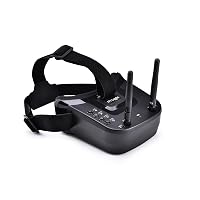 Speedybee5.8G FPV Goggles with Antennas: 3 Inch Screen 5.8G 40CH Build in… Speedybee5.8G FPV Goggles with Antennas: 3 Inch Screen 5.8G 40CH Build in… |
3.9Fair | — | 5.8G FPV Goggles with Antennas suits casual hobbyists seeking an ultra-compact, entry-level 3-inch screen headset designed exclusively for 5.8GHz 40-channel analog camera transmitters across small remote-control hobby craft. View listing |
Ratings are the star averages left by Amazon buyers, not scores from our own testing. Prices are the ones on the listing when this page was written.
FAQ
Does the DJI Goggles 3 work with older remote controllers?
The DJI Goggles 3 supports the DJI RC Motion 3, DJI FPV Remote Controller 3, DJI RC-N2, and DJI RC 2. However, it does not work with older transmitters such as the DJI RC Motion 2 or the first-generation DJI FPV Remote Controller, meaning operators must use compatible newer hardware.
How does the Real View PiP feature improve flight safety?
Real View PiP utilizes dual front-facing CMOS optical sensors to display a live feed of your physical surroundings inside a Picture-in-Picture window. This enables pilots to check their takeoff area, monitor equipment, or observe nearby personnel without physically taking the headset off during an active mission.
Can pilots adjust the lenses without wearing eyeglasses?
Yes, the headset features built-in diopter adjustment controls ranging from -6.0 D to +2.0 D. This allows nearsighted and farsighted operators to customize the optical focus directly on the unit without requiring third-party corrective lens inserts or wearing glasses inside the facial interface.
What is the battery runtime of the DJI Goggles 3?
The headset provides up to 3 hours of operating time on a full charge. The lithium-ion battery is integrated directly into the rear headband, which eliminates dangling cables and balances the overall weight across the pilot’s head during flight operations.
Can clients watch the live drone feed while the pilot flies?
Yes, the DJI Goggles 3 includes Wi-Fi wireless streaming functionality. This feature allows the headset to broadcast the live flight feed directly to a smartphone or tablet running the DJI Fly app, providing an accessible visual monitor for clients or spotters on site.
More Cameras & Drones ratings
See the section
Canon EOS M Breakdown: Minimalist Travel Camera Examined
Shoppers researching ultra-portable mirrorless options often compare early interchangeable-lens platforms against bulkier gear, questioning whether a compact setup can deliver professional-grade still imaging. The…

Olympus FE-370 Fast Assessment: Features and Fit
Evaluating vintage digital compacts requires understanding their core mechanical strengths and modern utility, and the Olympus FE-370 represents an accessible entry point into classic…

Sony Cyber-shot DSC-W370: Executive Buying Guide and Performance Review
For busy professionals who require a dependable visual capture device without the distraction of push notifications and workplace smartphone clutter, choosing the right pocket…

Canon EF 50mm f/1.8 STM: Quick Buying Verdict for Creators
Investing in a dependable standard prime often begins and ends with finding the right balance between optical clarity, physical weight, and low-light capability. If…
Buyer favourite 4.5+ stars from 500 or more ratings

Olympus Stylus Epic Zoom 80: The Decisive 35mm Film Review
Finding an everyday analog camera that balances pocketable convenience with dependable optics often leads photographers to the legendary Stylus lineup. The Olympus Stylus Epic…
Get new ratings by email
A weekly digest of the products added to the ratings pages.