Canon RF 75-300mm f/4-5.6: A Compact Reach for Fast-Paced Shooters
Shooting distant subjects without carrying a heavy, cumbersome setup is a persistent challenge for active photographers. The Canon RF 75-300mm f/4-5.6 directly targets this dilemma by providing extended telephoto reach in a…
By Brian Carver 9 min read

Canon RF 75-300mm f/4-5.6
Canon
Excellent
Our score: 9.4/10
Scores are out of 10, based on listed specifications and buyer feedback.
- Specs listed
- 11
- Section
- Cameras & Drones
Check price on Amazon We may earn a commission if you buy through this link.
As Amazon Associates, we earn from qualifying purchases. This means we may receive a small commission at no extra cost to you if you click through and make a purchase.
Shooting distant subjects without carrying a heavy, cumbersome setup is a persistent challenge for active photographers. The Canon RF 75-300mm f/4-5.6 directly targets this dilemma by providing extended telephoto reach in a compact, one-pound barrel engineered specifically for Canon mirrorless bodies. Photographers seeking an easy-to-manage telephoto zoom will find that this lens delivers critical reach for field sports, wildlife viewing, and travel portraits without demanding a bulky gear backpack. It operates across full-frame sensors while also serving APS-C camera bodies, where the focal crop pushes coverage to an impressive 120-480mm equivalent.
In this comprehensive canon rf 75-300mm review, we examine whether the optical trade-offs of an f/4-5.6 variable aperture make practical sense for your shooting workflow. Photographers pairing compact bodies with a versatile canon eos rp lens setup often need extended telephoto capability that preserves mobility. Throughout the following sections, we analyze the lens’s optical design, sharpness, autofocus tracking modes, ergonomic balance, bundled accessories, and overall field utility to help you decide if this compact telephoto zoom lens meets your creative demands.


What You Get With the Canon RF 75-300mm f/4-5.6
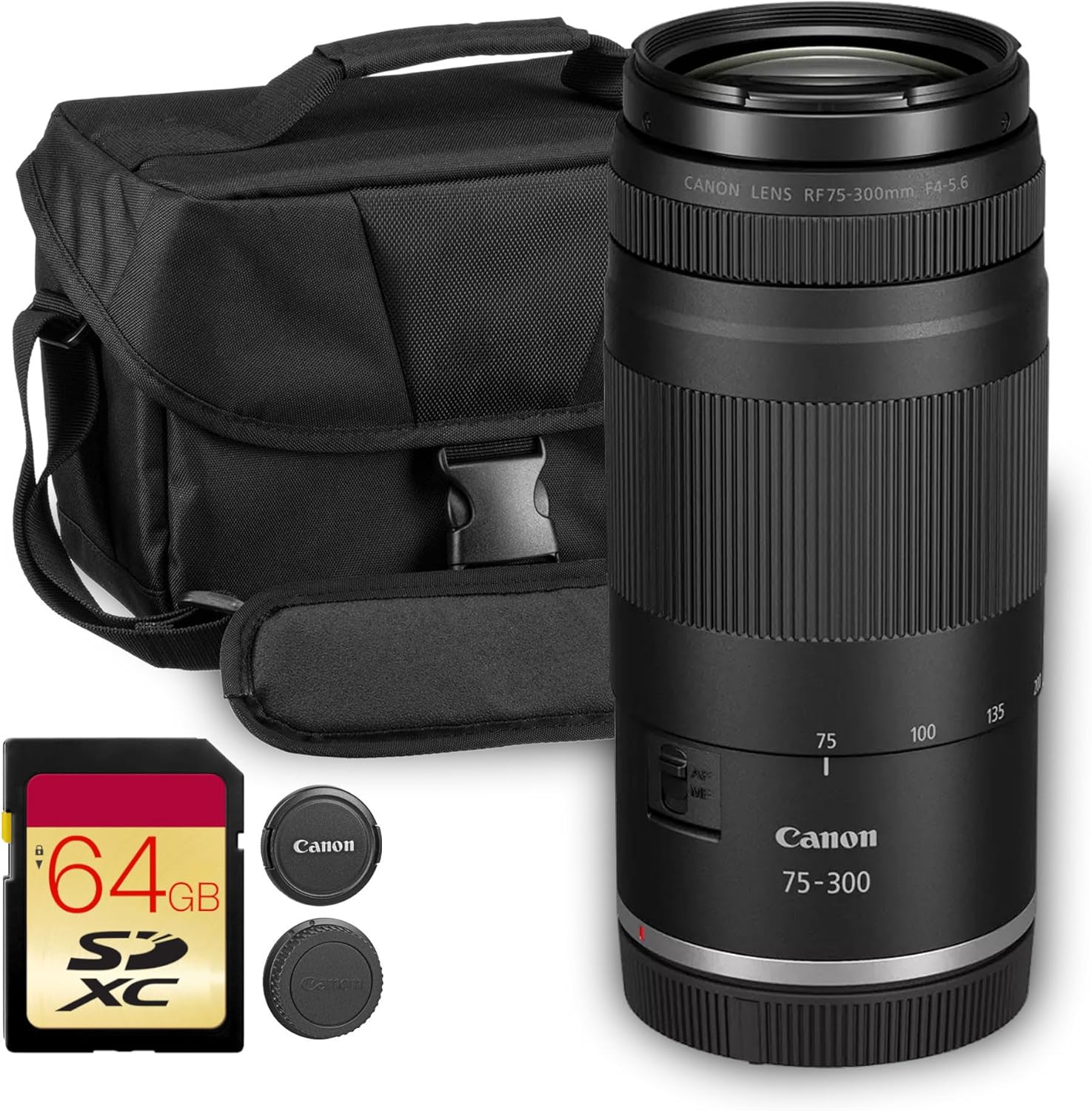
The product package arrives as an authorized bundle designed to provide essential gear right out of the packaging. Canon supplies the core optical unit alongside practical storage and capture accessories to ensure immediate field readiness.
In the box
- Canon RF 75-300mm f/4-5.6 lens with native Canon RF mount integration
- Dedicated protective carrying bag for safe transport and storage
- 64GB UHS-I SDXC memory card for high-capacity stills and video recording
- Canon USA Authorized retail backing
- Standard 58mm front filter thread for attaching protective or polarizing filters
- Integrated optical elements featuring Canon’s Super Spectra Coating
- Seven-blade circular aperture diaphragm for balanced background blur
- Close-up shooting capability with 0.25x magnification at a 4.9-foot minimum focus distance
Key Specifications
| Focal Length Range | 75-300mm (120-480mm equivalent on APS-C) |
|---|---|
| Maximum Aperture | f/4 – f/5.6 |
| Minimum Aperture | f/5.6 |
| Lens Mount | Canon RF |
| Item Weight | 16 ounces (just over 1 lb) |
| Dimensions (D x W x H) | 4"D x 3"W x 3"H |
| Front Filter Thread | 58mm |
| Minimum Focus Distance | 4.9 feet |
| Maximum Magnification | 0.25x |
| Focus Modes | Automatic AF (AF-A), Continuous-Servo AF (AF-C) |
| Aperture Diaphragm | 7 blades |
Figures as published by the manufacturer on the Amazon listing.
Optical Sharpness and Contrast Across the Focal Range
Achieving dependable image definition throughout a four-times telephoto zoom range requires thoughtful glass engineering. The optical structure of this lens is calibrated to maintain subject clarity from 75mm all the way through 300mm. Photographers evaluating canon rf 75-300mm sharpness will appreciate the implementation of Canon’s Super Spectra Coating. This specialized coating actively suppresses internal reflections, flare, and ghosting when you frame subjects against harsh sunlight or backlit sky conditions. As a result, color fidelity remains vibrant and contrast stays well-defined rather than washing out into hazy gray tones.
When comparing modern RF glass against historic legacy options like the older cannon ef 75-300mm lens, modern optical refinements provide noticeable gains in edge rendering and chromatic control. Beyond distant landscapes, the lens provides an engaging close-focus capability. With a minimum focusing distance of 4.9 feet and a maximum reproduction ratio of 0.25x, you can isolate medium-sized flora, detailed architectural fragments, or distant macro-style subjects with ease.
Out-of-focus background rendering is managed by a seven-blade circular aperture diaphragm. While variable zoom lenses with smaller maximum apertures are not designed primarily for extreme low-light portraiture, shooting at the 200mm to 300mm mark naturally compresses perspective and softens distant clutter. The seven blades produce a smooth, organic bokeh that separates your primary subject cleanly from distracting backgrounds in outdoor settings.
Autofocus Tracking and Action Performance
Telephoto shooting frequently involves subjects in motion, making reliable focusing modes essential for consistent results. The lens incorporates modern autofocus mechanics capable of running both Automatic AF (AF-A) and Continuous-Servo AF (AF-C) protocols. In sports and active scenarios, continuous tracking allows your mirrorless camera body to maintain lock on moving athletes, cycling subjects, or running pets as they traverse your composition. The canon rf 75-300mm autofocus system synchronizes with Canon RF-mount communication pins to deliver responsive tracking across stills and video capture.
Deploying the canon rf 75-300mm for sports delivers effective field flexibility when tracking players across open soccer pitches, baseball diamonds, or track lanes. Because the zoom quickly shifts between 75mm for mid-distance framing and 300mm for tight action shots, you do not need to pause and switch optics while the game progresses. While premium professional telephotos such as the canon rf 70-200mm f4 feature fixed maximum apertures and specialized ultrasonic drive motors, this RF 75-300mm focuses on providing accessible, versatile tracking for recreational and amateur athletic events.
For outdoor observers deploying the canon rf 75-300mm for wildlife, the lens offers sufficient reach to capture resting birds, deer in meadows, and zoo animals without disturbing their natural routines. The ability to toggle between single-point precision and continuous servo tracking ensures that when an animal abruptly alters course, the optical drive quickly reacquires focus rather than hunting repeatedly through the focal range.
Lightweight Handling and Field Mobility
Physical fatigue can quickly compromise a photography outing when carrying heavy gear over hours of walking. The canon rf 75-300mm weight stands out as one of its most compelling advantages, registering at just 16 ounces, or exactly one pound. Measuring a compact 4 inches in depth by 3 inches in width and height, the lens occupies minimal volume inside an everyday shoulder bag or backpack. This ultralight footprint makes it an exceptional companion for day hikes, family excursions, and casual travel where heavier telephoto gear would likely be left behind at home.
Photographers accustomed to older EF telephoto options, such as the canon ef 70-300mm f/4-5.6 is ii usm, will immediately notice the physical difference of a lens built natively for the shorter mirrorless flange distance. There is no requirement for a heavy metal mount adapter, which keeps front-heavy lever forces to a minimum when handholding your camera. The compact front element uses a modest 58mm filter diameter, reducing the physical size and carrying weight of any circular polarizers or neutral density filters you pack along.
Ergonomically, the modest dimensions allow fast transitions between horizontal and vertical shooting orientations. Handholding the lens for prolonged periods does not cause the wrist strain commonly experienced with large professional telephoto barrels. For busy shooters moving rapidly along the sidelines of an athletic match or hiking through a nature reserve, this lightweight build preserves personal energy and encourages spontaneous composition from unusual angles.
Managing Exposure and the Variable Aperture
Every optical design involves trade-offs, and understanding the canon rf 75-300mm f/4-5.6 specs is critical for planning exposure in the field. The lens utilizes a variable maximum aperture that opens to f/4 at the wide 75mm end and gradually narrows down to f/5.6 as you zoom toward the 300mm telephoto boundary. This variable construction is precisely what allows the lens to maintain its remarkably low 16-ounce weight and slender 3-inch barrel profile. However, it also dictates how much light reaches your sensor during exposure.
Under bright daylight, open stadium skies, or clear morning conditions, an aperture of f/5.6 provides plenty of light transmission to sustain high shutter speeds of 1/1000s or faster, which are vital for freezing sports and wildlife action. As ambient light levels diminish during dusk, heavy overcast weather, or indoor gymnasium events, you must adapt your shooting parameters. Mirrorless cameras with modern high-ISO performance allow you to elevate sensor sensitivity to compensate for the smaller aperture without introducing crippling amounts of noise into your final frames.
Because the listing does not specify optical image stabilization within the lens barrel, handheld stability relies primarily on shutter speed discipline or camera bodies equipped with In-Body Image Stabilization. Keeping your shutter speed at or above the reciprocal of your focal length—such as 1/320s or 1/500s when zoomed to 300mm—will safeguard your images against handheld blur. Mastering these exposure fundamentals ensures you harness the full telephoto benefit of this canon rf telephoto zoom lens across diverse daytime environments.
Canon RF 75-300mm f/4-5.6 Pros and Cons
Pros
- Lightweight 16-ounce build ensures effortless handheld operation
- Broad 75-300mm reach extends to 480mm on APS-C
- Super Spectra Coating controls flare and preserves contrast
- Close 4.9-foot minimum focusing distance enables semi-macro shots
- Includes 64GB SDXC card and dedicated protective bag
Cons
- Variable f/4-5.6 aperture restricts performance in dim lighting
- Listing does not specify built-in optical image stabilization
- Narrow f/5.6 maximum aperture at 300mm focal length
Check Canon RF 75-300mm f/4-5.6 on Amazon
Is the Canon RF 75-300mm f/4-5.6 Worth It
Deciding whether the canon rf 75-300mm is worth it depends entirely on your primary shooting subjects, mobility priorities, and typical lighting environments. If you are an outdoor sports enthusiast, a wildlife hobbyist, or a travel photographer seeking comprehensive telephoto reach in an easy-to-carry package, this lens delivers outstanding practical utility. The inclusion of a 64GB memory card and a dedicated carrying bag in the authorized bundle adds immediate field convenience without requiring additional accessory shopping.
For owners of APS-C camera bodies within the EOS R system, the lens presents an especially compelling value proposition. The 1.6x crop factor transforms the 75-300mm range into an effective 120-480mm field of view. Gaining near-500mm optical reach in a lens that weighs only one pound represents an extraordinarily lightweight wildlife and sports solution that few conventional full-frame lenses can match.
Conversely, professional photographers who spend the majority of their time working in dimly lit basketball arenas, indoor concert halls, or dark forest canopies may find the f/4-5.6 aperture limiting. If your assignments demand constant f/2.8 brightness or rugged weather-sealed construction, an advanced professional telephoto is more appropriate. But for fast-paced shooters working in natural light who prioritize packability and reach above all else, this compact zoom hits a very sweet spot.
Other Options to Consider
| Model | Our score | Why it is here |
|---|---|---|
 CanonCanon RF 75-300mm f/4-5.6 Compact Telephoto Zoom Lens (7155C002) BundleReviewed here |
9.4/10Excellent | The model reviewed on this page. View listing |
 TamronTamron 17-70mm f/2.8 Di III-A VC RXD Lens for Sony E APS-C… |
9.6/10Excellent | Tamron 17-70mm f 2.8 Di suits photographers shooting on Sony E-mount APS-C cameras who require a bright, constant f/2.8 standard zoom lens with vibration compensation rather than an extended Canon RF telephoto reach. View listing |
 SonySony FE 24-70mm F2.8 GM II Full-Frame Zoom Lens |
9.6/10Excellent | G-Master Standard Zoom Lens is designed for Sony full-frame mirrorless users who need a premium 24-70mm f/2.8 standard zoom for general commercial and event work instead of a dedicated lightweight telephoto optic. View listing |
 Canon RF 75-300mm F4-5.6 Telephoto Zoom Long-Range with Cleaning Kit Bundle |
9.4/10Excellent | For EOS R Mirrorless Cameras provides the exact same Canon RF 75-300mm f/4-5.6 telephoto zoom lens but bundles it with a filter kit, cap keeper, and cleaning kit instead of the single bag and 64GB SDXC card combination. View listing |
Scores are out of 10, based on listed specifications and buyer feedback. Prices are the ones on the listing when this page was written.
FAQ
Does the Canon RF 75-300mm f/4-5.6 work on APS-C mirrorless cameras?
Yes, the lens is compatible with both full-frame and APS-C Canon RF-mount mirrorless cameras. When mounted on an APS-C body, the camera’s sensor crop factor provides an effective focal length range of 120-480mm, granting significantly greater reach for distant sports and wildlife.
What filter size does the Canon RF 75-300mm f/4-5.6 use?
The lens features a front filter thread of 58mm. This compact diameter allows photographers to use small, lightweight, and readily available circular polarizers, UV filters, or neutral density filters without adding excess bulk.
What autofocus modes does this lens support?
According to the product specifications, the lens supports Automatic AF (AF-A) and Continuous-Servo AF (AF-C). These modes allow the autofocus system to lock onto static subjects or continuously track moving subjects across sports and action photography.
Does this lens package include memory storage?
Yes, the bundle includes a 64GB UHS-I SDXC memory card (with microSDXC compatibility noted in the specifications) along with a protective carrying bag and the lens itself.
Does the Canon RF 75-300mm f/4-5.6 feature built-in image stabilization?
The product listing does not specify built-in optical image stabilization. Photographers shooting in dimmer light or at the 300mm telephoto boundary will benefit from using faster shutter speeds or pairing the lens with a Canon mirrorless body equipped with In-Body Image Stabilization.
More Cameras & Drones ratings
See the section
Canon PowerShot S110 Review: Pocket-Sized Pro Imaging
When selecting a portable camera that balances manual control with true pocket convenience, the Canon PowerShot S110 remains a compelling tool for mobile visual…

DJI Osmo Action 6 Review: Decisive Buying Advice for Creators
Choosing a flagship action camera for fast-paced video production requires cutting through marketing noise to examine core capture hardware. The DJI Osmo Action 6…

Nikon Coolpix P500 Review: Practical Superzoom Performance
Photographers seeking broad reach without carrying heavy interchangeable lenses often turn to bridge cameras. The Nikon Coolpix P500 is an all-in-one bridge camera designed…

Tamron 12-20mm F/2.8 for Nikon Z: The Decisive Buying Guide
For landscape photographers, architectural specialists, and night sky shooters, choosing an ultra-wide zoom for the Nikon Z mount often requires navigating difficult compromises between…

Canon PowerShot ELPH 300 HS: Compact Pocket Camera Assessment
If you need an ultra-slim pocket camera for field documentation, business travel, or reliable everyday imaging without carrying heavy gear, the Canon PowerShot ELPH…
Get new ratings by email
A weekly digest of the products added to the ratings pages.