ASUS Ascent GX10 AI Supercomputer: Complete Professional Review
Engineering teams evaluating dedicated on-premise deep learning hardware face a critical architectural shift away from shared cloud instances and bulky rackmount servers. The ASUS Ascent GX10 represents a compact desktop alternative powered…
By Carla Fletcher 9 min read

ASUS Ascent GX10
ASUS
Fair
Our score: 7.6/10
Scores are out of 10, based on listed specifications and buyer feedback.
- Specs listed
- 11
- Section
- Computers & Laptops
Check price on Amazon We may earn a commission if you buy through this link.
As Amazon Associates, we earn from qualifying purchases. This means we may receive a small commission at no extra cost to you if you click through and make a purchase.
Engineering teams evaluating dedicated on-premise deep learning hardware face a critical architectural shift away from shared cloud instances and bulky rackmount servers. The ASUS Ascent GX10 represents a compact desktop alternative powered by the NVIDIA GB10 Grace Blackwell Superchip. By packaging 128GB of unified LPDDR5x memory alongside a Cortex processor and Blackwell GPU, this mini PC workstation aims to deliver 1 petaFLOP of AI compute directly to the developer desk. For technical leads managing proprietary model weights, stringent data privacy compliance, or unpredictable cloud billing, this specialized machine offers an isolated environment capable of fine-tuning models up to 200 billion parameters.
Determining whether this hardware delivers enough sustained performance to justify replacing workstation towers requires examining its unified memory throughput, software compatibility, and expansion capabilities. Unlike traditional multi-GPU x86 workstations, this desktop relies on NVIDIA DGX OS to deliver a full-stack development environment for autonomous workloads. In this assessment, we analyze the published technical capabilities, explore deployment scenarios for local language models and agentic workflows, assess dual-node stacking via high-speed networking, and examine alternative enterprise desktops to guide your infrastructure procurement decisions.



What You Get With the ASUS Ascent GX10
The ASUS Ascent GX10 is packaged as a specialized micro-supercomputer tailored for data scientists, machine learning researchers, and autonomous agent developers. Based on the manufacturer specifications, the package and system include the following core hardware elements and platform capabilities:
In the box
- ASUS Ascent GX10 AI Supercomputer compact desktop unit
- NVIDIA GB10 Grace Blackwell Superchip integrating Cortex CPU and Blackwell GPU architectures
- 128GB high-speed LPDDR5x unified system memory
- 2TB PCIe Gen4 NVMe solid-state drive
- Pre-installed NVIDIA DGX OS system software
- Integrated NVIDIA ConnectX-7 high-throughput networking
- Integrated Wi-Fi 7 and Bluetooth 5.4 wireless controllers
- Native platform support for OpenClaw and NemoClaw developer frameworks
- Stackable chassis housing with NVLink-C2C interconnect support
Key Specifications
| Manufacturer | ASUS |
|---|---|
| Product Category | Mini PC AI Supercomputer |
| Compute Engine | NVIDIA GB10 Grace Blackwell Superchip |
| CPU Architecture | Cortex @ 3.8 GHz with 16 MB Cache |
| Graphics Processing Unit | NVIDIA Blackwell GPU |
| Peak AI Compute | 1 PetaFLOP |
| System Memory | 128GB LPDDR5x Unified Architecture |
| Internal Storage | 2TB PCIe Gen4 NVMe SSD |
| System Software | NVIDIA DGX OS |
| High-Speed Networking | NVIDIA ConnectX-7, Wi-Fi 7, Bluetooth 5.4 |
| Primary Applications | AI Development, Machine Learning, AI Research |
All 63 attributes from the listing
| Specific Uses For Product | AI Development, AI Research, Machine Learning |
|---|---|
| Personal Computer Design Type | Mini PC |
| Color | Stellar Gray |
| Additional Features | 128GB RAM, NVIDIA ConnectX-7 SmartNIC, NVIDIA GB10 Superchip, Stackable Magnetic Feet, Ubuntu Linux OS |
| Hard Disk Description | SSD |
| Hardware Interface | Bluetooth 5, Ethernet, HDMI, USB 3.2 Gen 2×2 |
| Power Consumption | 240 watts |
| Item Dimensions | 5.91 x 5.91 x 2.01 inches |
| Item Weight | 3.3 pounds |
| Video Output Interface | HDMI |
| Hard Disk Interface | PCIE x 4 |
| Style Name | NVMe SSD |
| Cooling Method | Fan |
| Compatible Devices | Keyboard, Monitor, Mouse |
| Power Plug Type | Type B – 3 pin (North American) |
| Video Output | HDMI |
| Graphics Description | Nvidia GB10 Blackwell GPU |
| Graphics Coprocessor | Blackwell GPU |
| Graphics Card Ram | 128 GB |
| Graphics Ram Type | Shared |
| Graphics Card Interface | PCI Express |
| Processor Series | Cortex |
| Processor Speed | 3.8 GHz |
| Processor Count | 1 |
| CPU Model Speed Maximum | 4 GHz |
| Total Usb Ports | 4 |
| Total Number of HDMI Ports | 1 |
| Number of Component Outputs | 1 |
| Human-Interface Input | Buttons |
| Keyboard Description | External keyboard required (not included) |
| Keyboard Layout | QWERTY |
| Brand | ASUS |
| Model Number | GX10-GG0020BN |
| Model Name | GX10-GG0020BN |
| Built-In Media | GX10-GG0020BN, Power Adapter, Power Cord |
| Processor Brand | NVIDIA |
| CPU Model Number | GB10 |
| Warranty Description | 1 Year Manufacturer |
| Unit Count | 1 Count |
| UPC | 199291249882 |
| Manufacturer | ASUS |
| Best Sellers Rank | #5,393 in Electronics (See Top 100 in Electronics) #948 in Mini Computers |
| ASIN | B0GBXPZ8V8 |
| Cache Memory Installed Size | 16 MB |
| Memory Storage Capacity | 128 GB |
| RAM Memory Installed | 128 GB |
| RAM Memory Technology | LPDDR5x |
| Ram Memory Maximum Size | 128 GB |
| Memory Speed | 6400 mt s |
| RAM Type | DDR5 RAM |
| Memory Clock Speed | 8533 MHz |
| Display Resolution Maximum | 3840×2160 pixels |
| Aspect Ratio | 16:9 |
| Resolution | 4K |
| Native Resolution | 3840 x 2160 |
| Connectivity Technology | 10G LAN, Bluetooth 5.4, HDMI, USB, Wi-Fi 7 |
| Wireless Compability | 802.11.be, Bluetooth |
| Wireless Technology | Bluetooth, Wi-Fi |
| CPU Model | Cortex |
| CPU Speed | 3.8 GHz |
| Cache Size | 16 MB |
| Graphics Card Description | Nvidia GB10 Blackwell GPU |
| Personal computer design type | Mini PC |
Figures as published by the manufacturer on the Amazon listing.
Compute Architecture and Unified Memory Throughput
At the center of the hardware design is the NVIDIA Grace Blackwell architecture, which redefines how local workstations allocate computational resources. When evaluating the ASUS Ascent GX10 specs, the most defining attribute is the tight integration between the Cortex central processor and the Blackwell graphics processing engine. Running at a base clock of 3.8 GHz with a 16 MB cache, the CPU subsystem manages data pipelines efficiently while delegating heavy matrix math directly to the GPU core, unlocking an estimated 1 petaFLOP of AI throughput for enterprise workloads.
Conventional workstation builds frequently struggle with bandwidth bottlenecks over discrete PCIe lanes when transferring tensors between system RAM and discrete video cards. The ASUS Ascent GX10 addresses this constraint by implementing 128GB of unified LPDDR5x memory linked via NVIDIA NVLink-C2C. Because the system memory is shared natively across processing cores without traditional bus translation steps, memory-intensive training loops and inference jobs access model weights simultaneously. Teams analyzing system memory constraints against multi-card towers like the gigabyte ai top will note that unified architecture provides superior memory density within a fraction of the physical space.
This shared pool is specifically targeted at parameter-heavy model adaptation. With 128GB of high-density memory accessible to the execution units, the machine supports fine-tuning models scaling up to 200 billion parameters. By keeping the complete computational state inside local silicon memory, developers can run extensive iterative experiments without triggering out-of-memory errors or resorting to aggressive parameter quantization that degrades output quality.
Local Large Language Models and Agentic AI Workflows
Deploying large language models directly on local hardware has transitioned from an experimental preference to an enterprise compliance requirement. Using the ASUS Ascent GX10 for machine learning enables engineering groups to build, test, and run private on-device inference without transmitting sensitive proprietary codebases or customer records to third-party endpoints. Because the unit ships with NVIDIA DGX OS, developers receive an operating environment optimized from the kernel level upward to execute containerized AI microservices, inference servers, and data preprocessing scripts.
Autonomous agent architectures demand sustained execution loops, continuous tool-calling capabilities, and sandboxed runtimes. The platform is preconfigured for modern autonomous frameworks, providing verified integration with OpenClaw and NemoClaw tooling. These frameworks permit developers to govern data access, restrict system privileges, and run autonomous execution routines in segregated environments. For organizations deploying multi-step autonomous pipelines, the ASUS Ascent GX10 provides the reliable compute necessary to run persistent background reasoning without resource starvation.
Standard consumer workstations and portable productivity machines such as the asus zenbook s are built around everyday operating systems that introduce background scheduling latency and memory fragmentation. In contrast, this dedicated mini PC operates strictly as an AI engineering platform. The software stack integrates driver-level scheduling, telemetry, and mathematical compute libraries designed specifically to maximize hardware utilization during complex, non-interactive transformer model evaluations.
Chassis Design and Thermal Engineering in Practice
Achieving dense computational throughput inside a compact desktop form factor requires rigorous heat dissipation management. The system is housed inside an ultra-small form factor desktop chassis engineered for quiet operational stability on standard laboratory benches or executive desks. ASUS has integrated an advanced thermal layout designed to pull air across the superchip and exhaust heat rapidly, preventing the clock throttling that frequently impairs high-density silicon during sustained training passes.
Thermal stability is a frequent vulnerability for compact systems attempting enterprise-grade matrix math. While portable creator machines like the asus rog zephyrus g14 32gb ram feature impressive peak hardware, their physical enclosures inevitably restrict continuous power delivery during multi-hour fine-tuning tasks. The desktop housing of the Ascent GX10 balances form-factor convenience with the sustained acoustic and thermal headroom required for uninterrupted compute jobs lasting multiple days.
The compact industrial enclosure also simplifies enterprise physical management. While the listing does not specify external decibel metrics, port counts, or gross unit weight, the mini PC profile ensures simple repositioning between developer desks and secure server closets. The integrated 2TB PCIe Gen4 NVMe solid-state drive provides local storage for datasets, base model checkpoints, and container images, minimizing latency when swapping foundational weights into memory.
Multi-Node Scaling and Network Interconnects
Modern machine learning engineering occasionally scales beyond the boundaries of a single desktop node. To address this demand, the hardware incorporates an integrated NVIDIA ConnectX-7 network interface alongside a physical stackable chassis profile. ConnectX-7 provides ultra-low latency and enterprise-grade networking throughput, allowing developers to connect dual GX10 systems into a collaborative processing pool without the throughput degradation common to standard Gigabit Ethernet adapters.
The inclusion of NVIDIA NVLink-C2C interconnect support ensures that multi-chassis deployments can maintain coherent data communication across nodes. By stacking two units, engineering teams can double their processing resources and scale memory pools to accommodate larger context windows and heavier fine-tuning pipelines. This multi-node capability effectively bridges the gap between single-user desktop development and large-scale data center cluster deployment.
For standard local connectivity, the hardware incorporates modern wireless standards, including Wi-Fi 7 and Bluetooth 5.4. These interfaces facilitate fast integration into corporate local area networks and enable straightforward connections for peripherals. Whether operating as an isolated air-gapped testbench or integrated into an automated continuous-integration cluster, the system provides flexible connectivity protocols suited for enterprise engineering environments.
ASUS Ascent GX10 Pros and Cons
Pros
- NVIDIA GB10 Superchip with 1 petaFLOP compute
- 128GB unified memory for 200B parameter models
- ConnectX-7 networking for dual-system stacking
- Pre-configured enterprise NVIDIA DGX OS platform
- Ultra-compact stackable mini PC form factor
Cons
- Fixed 128GB unified memory cannot be upgraded
- Operates exclusively on specialized NVIDIA DGX OS
- Tailored strictly for AI workflows rather than general computing
Check ASUS Ascent GX10 on Amazon
Is the ASUS Ascent GX10 Worth It
Evaluating whether this specialized hardware delivers sufficient value depends entirely on your primary computing workflow. For enterprise machine learning engineers, AI safety researchers, and development teams tasked with deploying agentic workflows, the hardware represents a compelling, self-contained compute engine. The unified 128GB LPDDR5x architecture and NVIDIA DGX OS platform eliminate traditional PCIe bottlenecks, making it an exceptional investment for private inference and local model adaptation up to 200 billion parameters.
Conversely, this hardware is entirely unsuited for general-purpose desktop computing, administrative operations, or standard corporate productivity suites. Because it runs NVIDIA DGX OS rather than a consumer operating system like Windows, it will not support traditional office productivity programs, CAD software, or digital media creation applications. If your daily workflow does not center specifically on local tensor math, transformer model hosting, and AI agent sandboxing, an enterprise x86 workstation remains the practical path.
For engineering departments spending substantial resources on remote cloud compute instances, the Ascent GX10 justifies its role by removing queue delays and recurring data transfer charges. By providing predictable, high-performance silicon on the developer desk, it provides immediate validation cycles for experimental architectures while preserving total data sovereignty.
Other Options to Consider
| Model | Our score | Why it is here |
|---|---|---|
 ASUSASUS Ascent GX10 AI Supercomputer, DGX Spark, NVIDIA GB10 Superchip, 128GB LPDDR5x,…Reviewed here |
7.6/10Fair | The model reviewed on this page. View listing |
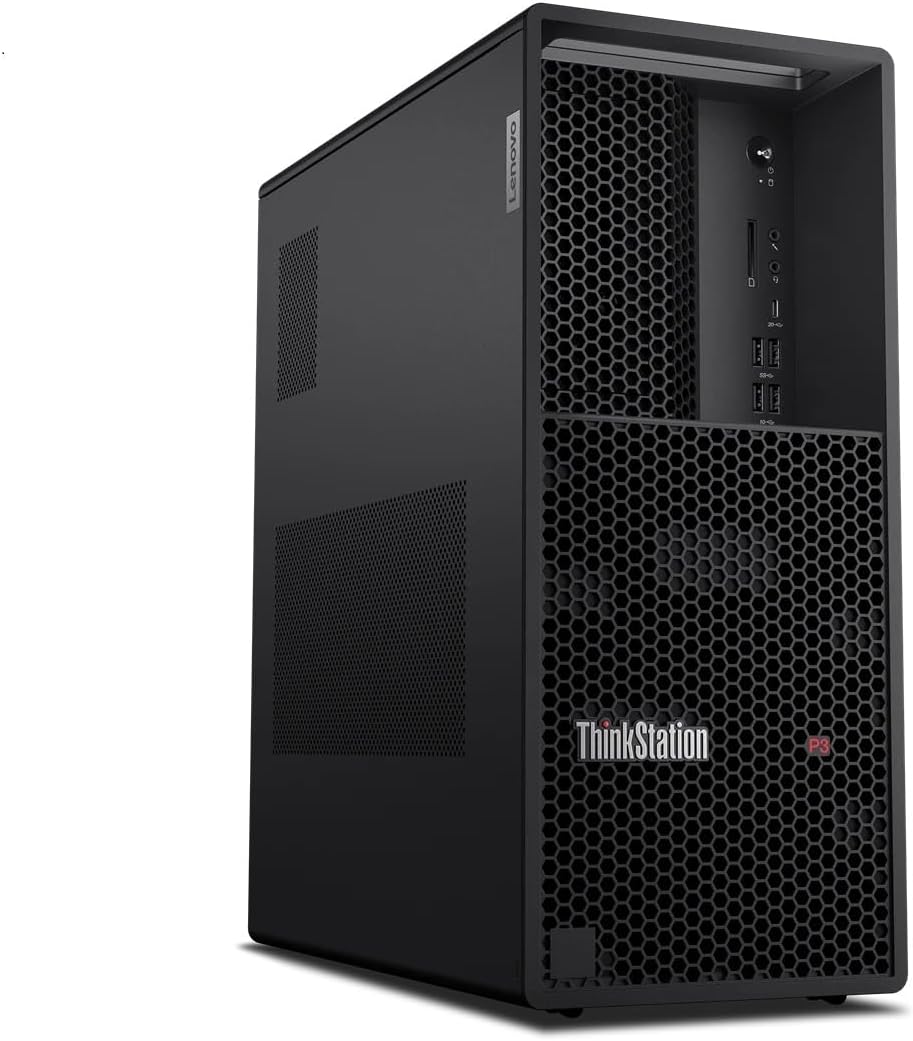
 LenovoLenovo ThinkStation P3 Tower with Ultra 9 285, 64GB DDR5, NVIDIA RTX… |
10.0/10Excellent | Ada Generation 16GB GDDR6 Lenovo ThinkStation P3 Tower is powered by an Intel Core Ultra 9 285 processor, 64GB of DDR5 RAM, a 1TB SSD, Wi-Fi 7, Windows 11 Pro, and an NVIDIA RTX 2000 Ada graphics card with 16GB of GDDR6 memory, making it a better fit for technical professionals who require a conventional Windows workstation for CAD, 3D modeling, and entry-level GPU workloads. View listing |
 LenovoLenovo ThinkStation P3 Mini Desktop, Intel Core i5-14500, 32GB DDR5+ 2TB |
10.0/10Excellent | Tiny Workstation Lenovo ThinkStation P3 Mini Desktop integrates an Intel Core i5-14500 CPU, 32GB of DDR5 memory, a 2TB storage drive, Windows 11 Pro, desktop mounting accessories, and display support for up to four monitors, serving as an ideal option for corporate users seeking an ultra-compact office desktop for everyday multi-screen productivity rather than heavy AI computation. View listing |
 LenovoLenovo ThinkStation P3 Tower Gen 2 Workstation: Intel Core Ultra 9 285… |
9.2/10Very good | Lenovo ThinkStation P3 Tower Gen 2 Workstation features an Intel Core Ultra 9 285 vPro processor, 256GB of high-speed DDR5 6400MHz memory, a 2TB Gen 5 NVMe SSD, and an NVIDIA RTX 4000 Ada graphics card on Windows 11 Pro, offering a superior platform for enterprise engineers who need massive system RAM capacities, PCIe add-in expansion, and full compatibility with traditional professional business applications. View listing |
Scores are out of 10, based on listed specifications and buyer feedback. Prices are the ones on the listing when this page was written.
FAQ
What operating system is installed on the ASUS Ascent GX10?
The ASUS Ascent GX10 comes pre-installed with NVIDIA DGX OS, an enterprise-grade Linux distribution specifically engineered to support the NVIDIA AI software stack, container runtimes, and local deep learning workflows.
Can the internal memory on the ASUS Ascent GX10 be expanded?
The system features 128GB of unified LPDDR5x memory integrated directly into the superchip package; the listing does not specify individual user-accessible DIMM slots, meaning physical memory capacity is fixed at the hardware level.
How does the NVIDIA GB10 Grace Blackwell Superchip handle local AI models?
The GB10 Superchip integrates a Cortex CPU with a Blackwell GPU connected by NVIDIA NVLink-C2C, providing 1 petaFLOP of AI performance and unified access to 128GB of high-speed memory for fine-tuning models up to 200 billion parameters.
Can multiple ASUS Ascent GX10 systems be clustered together?
Yes, the hardware includes an integrated NVIDIA ConnectX-7 network interface and features a stackable chassis design, allowing organizations to link dual GX10 systems together to scale compute and memory capacity across nodes.
What AI frameworks are supported on this desktop out of the box?
The platform is optimized for developer workflows with explicit support for autonomous agent frameworks such as OpenClaw and NemoClaw, alongside standard machine learning libraries supported within the enterprise NVIDIA AI software ecosystem.
More Computers & Laptops ratings
See the section
Lenovo V15 Gen 4 Analysis: Practical Performance for Modern Work
The Lenovo V15 Gen 4 is designed for enterprise professionals, remote contractors, and corporate departments seeking a reliable business notebook built for daily office…

Lenovo LOQ 15 Review: Is the RTX 4050 and 16GB Configuration Right for You?
Shoppers considering the Lenovo LOQ 15 configured with an NVIDIA GeForce RTX 4050 and 16GB of DDR5 memory generally want to know whether this…
Lenovo IdeaPad 5 Assessment: Dependable Everyday Productivity
Selecting the right mid-tier business laptop often comes down to balancing responsive computing speed against everyday functional reliability. The Lenovo IdeaPad 5 configured with…

Lenovo ThinkBook 14 Intel: The Professional Efficiency Review
For corporate operators and mobile specialists weighing their next workstation purchase, the Lenovo ThinkBook 14 provides an assertive balance between high-end compute potential and…

HP OmniBook X Flip 16 Review: Executive Efficiency Tested
Choosing a full-sized 2-in-1 machine requires balancing screen area against transportability, and the HP OmniBook X Flip 16 targets mobile professionals who refuse to…
Get new ratings by email
A weekly digest of the products added to the ratings pages.